

Weight measurement plays a critical role in everyday life, from tracking fitness progress and calculating shipping costs to understanding product labels and international travel requirements. Yet many people still find themselves switching between metric and imperial systems and wondering exactly how the conversion works.
One of the most common questions is: How Many Pounds in a Kilogram?
The answer is straightforward:
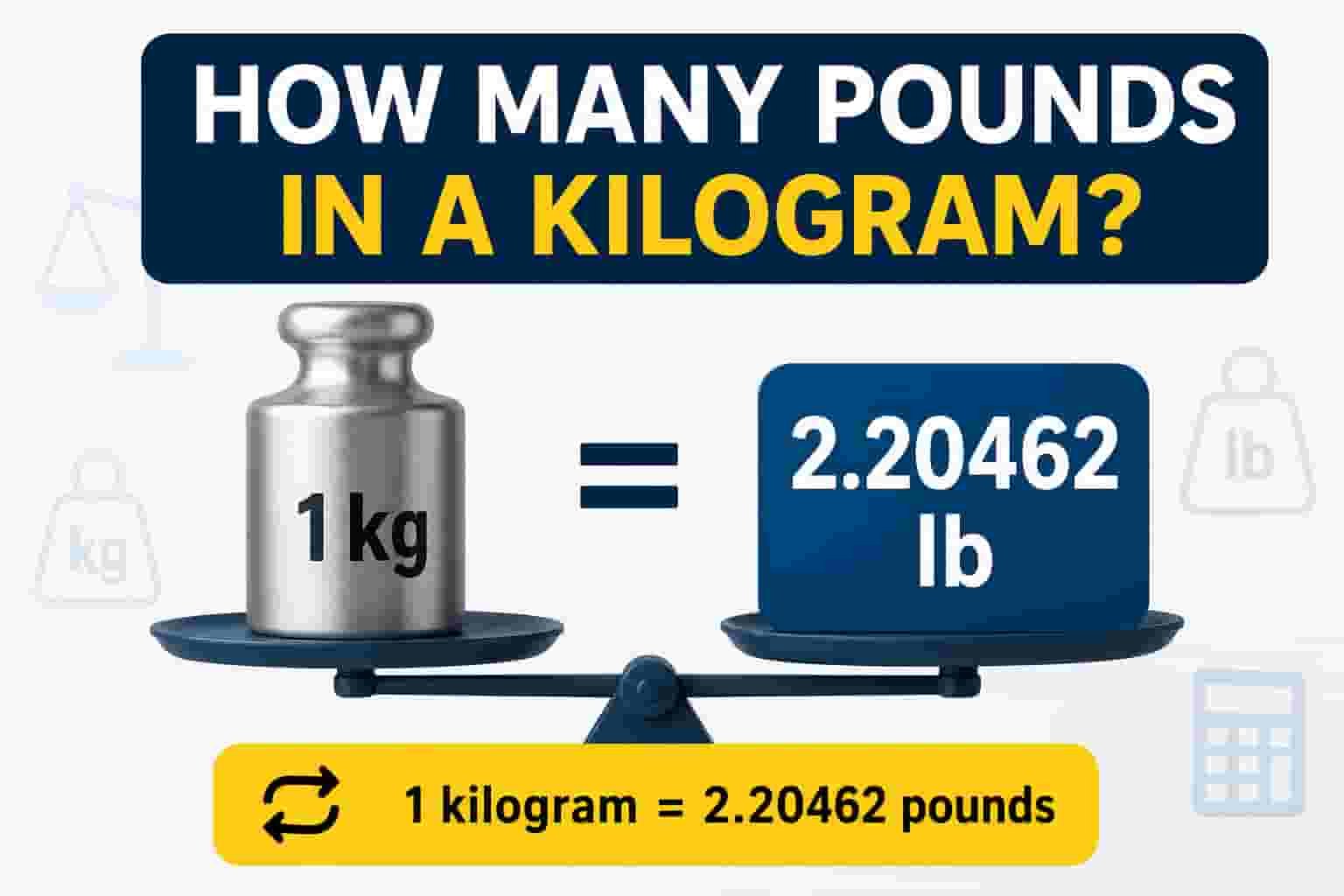
1 kilogram (kg) = 2.20462 pounds (lbs)
This conversion factor is used worldwide in science, healthcare, commerce, sports, and logistics. Understanding it can help you quickly convert weights and avoid confusion when dealing with different measurement systems.
In this comprehensive guide, you’ll learn the exact conversion formula, practical examples, conversion tables, real-world applications, and answers to frequently asked questions.
Understanding Kilograms and Pounds
Before learning the conversion process, it’s important to understand the units themselves.
What Is a Kilogram?
A kilogram is the base unit of mass in the International System of Units (SI), commonly known as the metric system.
The kilogram is used by:
- Most countries worldwide
- Scientists and researchers
- Healthcare professionals
- Manufacturers
- Educational institutions
The metric system is valued because it uses multiples of ten, making calculations simpler and more consistent.
What Is a Pound?
A pound (lb) is a unit of weight used primarily in:
- The United States
- Some parts of the United Kingdom
- Certain industries worldwide
The pound belongs to the imperial and U.S. customary measurement systems.
Today, the international avoirdupois pound is officially defined as exactly 0.45359237 kilograms.
READ: 500 Miles and I Would Walk Lyrics
How Many Pounds in a Kilogram?
The standard conversion is:
1 kilogram = 2.20462 pounds
This means that every kilogram contains slightly more than two pounds.
Quick Reference
| Kilograms | Pounds |
| 1 kg | 2.20462 lbs |
| 2 kg | 4.40924 lbs |
| 5 kg | 11.0231 lbs |
| 10 kg | 22.0462 lbs |
| 20 kg | 44.0925 lbs |
| 50 kg | 110.231 lbs |
| 100 kg | 220.462 lbs |
For everyday use, many people round the conversion factor to 2.2 pounds per kilogram.
The Formula for Converting Kilograms to Pounds
To convert kilograms into pounds, use the following formula:
Pounds = Kilograms × 2.20462
Example 1
If a person weighs 60 kilograms:
60 × 2.20462 = 132.277 pounds
Result:
60 kg = 132.28 lbs
Example 2
If a suitcase weighs 15 kilograms:
15 × 2.20462 = 33.069 pounds
Result:
15 kg = 33.07 lbs
Example 3
If a package weighs 3.5 kilograms:
3.5 × 2.20462 = 7.716 pounds
Result:
3.5 kg = 7.72 lbs
Why This Conversion Matters
Understanding weight conversion has practical benefits in many areas of life.
Fitness and Health Tracking
Most countries report body weight in kilograms, while many fitness resources in the United States use pounds.
For example:
- 70 kg = 154.32 lbs
- 80 kg = 176.37 lbs
- 90 kg = 198.42 lbs
Athletes, personal trainers, and healthcare professionals frequently convert between these units.
Travel and Airline Baggage
Airlines often publish baggage limits in kilograms, especially for international flights.
Examples:
| Baggage Allowance | Equivalent in Pounds |
| 20 kg | 44.09 lbs |
| 23 kg | 50.71 lbs |
| 30 kg | 66.14 lbs |
Knowing the conversion helps travelers avoid overweight baggage fees.
Shipping and Logistics
Global shipping companies routinely convert between metric and imperial systems.
Package dimensions and weights often need to comply with regional standards, making accurate conversion essential.
Medical Applications
Healthcare professionals worldwide rely heavily on kilograms.
Research published by organizations such as the World Health Organization (WHO) shows that body weight, medication dosages, and growth assessments are commonly recorded in kilograms to maintain international consistency.
However, patients in countries using pounds may require weight conversions for better understanding.
Historical Background of Kilograms and Pounds
Origin of the Kilogram
The kilogram was introduced during the French Revolution as part of the metric system.
Over time, it became the global standard for scientific and commercial measurements.
In 2019, the kilogram was redefined using the Planck constant, making it based on fundamental physical constants rather than a physical object.
Origin of the Pound
The pound traces its roots back to ancient Roman measurement systems.
Various versions existed throughout history until the international pound was standardized in 1959.
Today, the pound remains widely used in the United States and several specialized industries worldwide.
Common Kilogram-to-Pound Conversions
Many people repeatedly convert the same weights.
Here are some of the most common values.
| Kilograms | Pounds |
| 1 kg | 2.20 lbs |
| 2 kg | 4.41 lbs |
| 3 kg | 6.61 lbs |
| 4 kg | 8.82 lbs |
| 5 kg | 11.02 lbs |
| 10 kg | 22.05 lbs |
| 15 kg | 33.07 lbs |
| 20 kg | 44.09 lbs |
| 25 kg | 55.12 lbs |
| 30 kg | 66.14 lbs |
| 40 kg | 88.18 lbs |
| 50 kg | 110.23 lbs |
| 75 kg | 165.35 lbs |
| 100 kg | 220.46 lbs |
Mental Math Tricks for Quick Conversion
While calculators provide exact results, mental estimation can be useful.
Method 1: Multiply by 2.2
Since one kilogram equals approximately 2.2 pounds:
10 kg ≈ 22 lbs
25 kg ≈ 55 lbs
50 kg ≈ 110 lbs
This method works well for everyday situations.
Method 2: Double and Add 10%
Another easy approximation:
- Double the kilogram value.
- Add 10% of the result.
Example:
20 kg
- Double = 40
- Add 10% (4)
Approximate answer = 44 lbs
Actual answer = 44.09 lbs
The estimate is very close.
Kilograms vs Pounds: Which System Is Better?
Neither system is inherently better; each serves different regions and purposes.
Advantages of Kilograms
- International standard
- Widely used in science
- Easier decimal calculations
- Consistent metric structure
Advantages of Pounds
- Familiar to U.S. consumers
- Common in certain industries
- Deep historical usage
The metric system is currently used by more than 95% of the world’s population, making kilograms the dominant global measurement standard.
Weight Conversion in Sports and Fitness
Sports organizations frequently publish athlete weights in both units.
For example:
| Weight in Kilograms | Weight in Pounds |
| 57 kg | 125.66 lbs |
| 68 kg | 149.91 lbs |
| 75 kg | 165.35 lbs |
| 81 kg | 178.57 lbs |
| 91 kg | 200.62 lbs |
Combat sports such as boxing, wrestling, and mixed martial arts often use both measurement systems to accommodate international audiences.
Scientific Accuracy and Precision
In scientific and medical settings, precision matters.
The exact conversion factor is:
1 kg = 2.20462262185 lbs
For most practical purposes, this is rounded to:
1 kg = 2.20462 lbs
Using additional decimal places is usually unnecessary unless performing laboratory or engineering calculations.
Real-World Examples
Example: Body Weight
A person weighs 72 kilograms.
72 × 2.20462 = 158.73 pounds
Result:
72 kg = 158.73 lbs
Example: Gym Weight Plate
A weight plate weighs 20 kilograms.
20 × 2.20462 = 44.09 pounds
Result:
20 kg = 44.09 lbs
Example: Pet Weight
A dog weighs 12 kilograms.
12 × 2.20462 = 26.46 pounds
Result:
12 kg = 26.46 lbs
Example: Shipping Parcel
A package weighs 8 kilograms.
8 × 2.20462 = 17.64 pounds
Result:
8 kg = 17.64 lbs
Common Conversion Mistakes
Avoid these frequent errors.
Using 2 Instead of 2.20462
Some people simply double the kilogram value.
Example:
10 kg × 2 = 20 lbs
Correct answer:
10 kg × 2.20462 = 22.05 lbs
This creates a noticeable difference.
Confusing Mass and Weight
Technically:
- Kilograms measure mass.
- Pounds can represent weight or mass depending on context.
In everyday use, the distinction rarely matters, but scientific applications require precision.
Rounding Too Aggressively
Rounding is fine for estimates but not for medical, engineering, or shipping calculations.
Frequently Asked Questions
How many pounds are in exactly 1 kilogram?
One kilogram equals 2.20462 pounds.
Is 1 kilogram equal to 2 pounds?
Not exactly.
One kilogram equals approximately 2.2 pounds, which is slightly more than 2 pounds.
How do I convert kilograms into pounds quickly?
Multiply the kilogram value by 2.2 for a close estimate.
What is 5 kilograms in pounds?
5 × 2.20462 = 11.0231 pounds.
Rounded:
5 kg = 11.02 lbs
What is 10 kilograms in pounds?
10 × 2.20462 = 22.0462 pounds.
Rounded:
10 kg = 22.05 lbs
What is 50 kilograms in pounds?
50 × 2.20462 = 110.231 pounds.
Rounded:
50 kg = 110.23 lbs
Why do some countries use kilograms while others use pounds?
Most countries adopted the metric system because of its simplicity and international standardization.
The United States continues to use pounds as part of its customary measurement system.
Which unit is used in healthcare?
Most healthcare organizations use kilograms because it provides a universal standard for medical records and medication calculations.
Are kilograms more accurate than pounds?
Neither unit is inherently more accurate.
Accuracy depends on the measuring instrument and calculation method.
Can I use 2.2 instead of 2.20462?
Yes, for everyday estimates.
For professional calculations, use the full conversion factor.
Conclusion
Understanding How Many Pounds in a Kilogram is useful for health tracking, travel, sports, shipping, education, and everyday life. The key conversion is simple:
1 kilogram = 2.20462 pounds
With this conversion factor, you can quickly translate weights between the metric and imperial systems and avoid costly mistakes in situations where precision matters.
Whether you’re checking body weight, packing luggage, calculating shipping costs, or analyzing fitness data, knowing this relationship makes international measurements much easier to understand.
Key Takeaways
- 1 kilogram equals 2.20462 pounds.
- To convert kilograms to pounds, multiply by 2.20462.
- A quick estimate uses 2.2 pounds per kilogram.
- Kilograms are the global standard measurement unit.
- Pounds remain common in the United States and some industries.
- Accurate conversions are important for health, travel, shipping, and sports.
- Common weights like 10 kg, 20 kg, and 50 kg convert to 22.05 lbs, 44.09 lbs, and 110.23 lbs respectively.
