

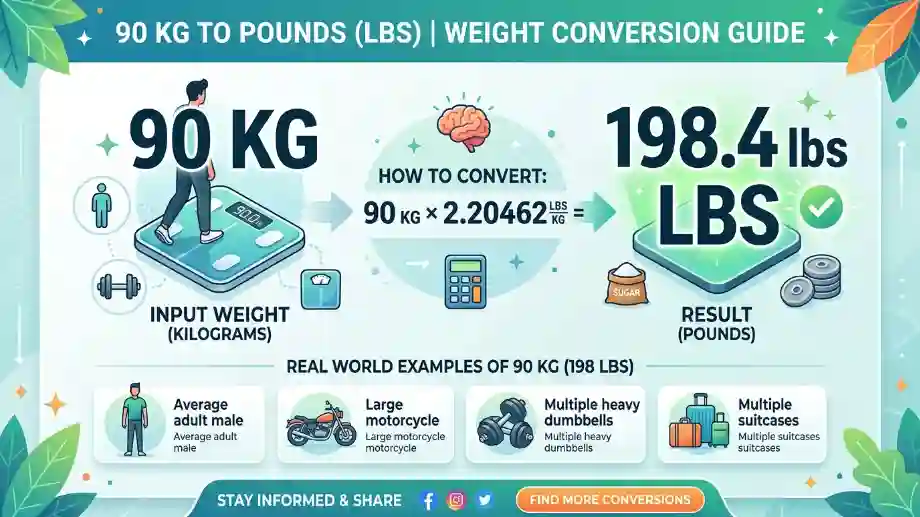
Understanding weight conversions is important in everyday life, especially when dealing with international measurements. Whether you’re tracking fitness goals, calculating shipping weights, following a nutrition plan, or interpreting medical records, knowing how to convert kilograms into pounds can save time and prevent mistakes.
The exact conversion of 90 KG to Pounds is:
90 kilograms = 198.42 pounds (lbs)
This guide explains the conversion formula, provides practical examples, discusses when you may need this calculation, and answers the most common questions people ask about kilogram-to-pound conversions.
90 KG to Pounds: Quick Answer
If you need a fast conversion:
| Kilograms (kg) | Pounds (lbs) |
| 90 kg | 198.42 lbs |
Using the standard conversion factor:
1 kilogram = 2.20462 pounds
Therefore:
90 × 2.20462 = 198.42 pounds
So, 90 KG to Pounds equals 198.42 lbs.
Understanding Kilograms and Pounds
Before converting between units, it’s helpful to understand what each measurement represents.
What Is a Kilogram?
A kilogram (kg) is the standard unit of mass in the International System of Units (SI).
It is commonly used in:
- Europe
- Asia
- Africa
- Australia
- Most countries worldwide
Examples include:
- Body weight
- Food measurements
- Scientific calculations
- Commercial shipping
What Is a Pound?
A pound (lb or lbs) is a unit of weight primarily used in:
- United States
- Some parts of the United Kingdom
- A few other countries using imperial measurements
Pounds are commonly seen in:
- Fitness tracking
- Medical records
- Retail products
- Shipping services
How to Convert 90 Kilograms to Pounds
The conversion process is straightforward.
Formula
Pounds = Kilograms × 2.20462
Calculation
90 × 2.20462 = 198.4158
Rounded to two decimal places:
90 kg = 198.42 lbs
This means that 90 KG to Pounds converts precisely to 198.42 pounds.
Why the Conversion Factor Is 2.20462
The relationship between kilograms and pounds is based on internationally recognized standards.
According to international measurement standards:
- 1 kilogram = 2.20462 pounds
- 1 pound = 0.453592 kilograms
These conversion factors are used globally in:
- Scientific research
- Healthcare
- Engineering
- International trade
- Sports competitions
Because these values are standardized, they provide highly accurate results.
READ MORE: Hectares to Acres: The Complete Conversion Guide
Conversion Table for Nearby Weights
Many people searching for weight conversions also want to compare nearby values.
| Kilograms | Pounds |
| 85 kg | 187.39 lbs |
| 86 kg | 189.60 lbs |
| 87 kg | 191.80 lbs |
| 88 kg | 194.01 lbs |
| 89 kg | 196.21 lbs |
| 90 kg | 198.42 lbs |
| 91 kg | 200.62 lbs |
| 92 kg | 202.83 lbs |
| 93 kg | 205.03 lbs |
| 94 kg | 207.23 lbs |
| 95 kg | 209.44 lbs |
This table helps you estimate weight changes without performing repeated calculations.
Real-World Examples of 90 kg
To better understand what 90 kilograms represents, consider these examples.
Adult Body Weight
A weight of 90 kg (198.42 lbs) is common among:
- Taller adults
- Athletes with significant muscle mass
- Individuals engaged in strength training
Gym and Fitness
Many strength-training enthusiasts track body weight in both kilograms and pounds because:
- Most countries use kilograms.
- Many fitness resources from the United States use pounds.
For example:
- A person weighing 90 kg weighs approximately 198 lbs.
- A powerlifter competing internationally may need both measurements.
Travel and Luggage
Airlines often use kilograms for baggage limits.
If a cargo shipment weighs 90 kg:
- It equals approximately 198.42 lbs.
This conversion helps when dealing with international shipping companies.
When Do You Need to Convert Kilograms to Pounds?
There are several situations where conversions become necessary.
Fitness and Weight Loss
Many workout programs, calorie calculators, and health resources use pounds.
For example:
- A fitness app may ask for weight in lbs.
- Your scale may display weight in kg.
Converting ensures accurate tracking.
Medical Purposes
Healthcare professionals often work with both systems.
Certain medications, dosage calculations, and health assessments may require conversions between kilograms and pounds.
International Travel
Travelers moving between countries often encounter different measurement systems.
Examples include:
- Airline baggage rules
- Sports competitions
- Health documentation
Online Shopping
Some international retailers list product weights in kilograms, while others use pounds.
Understanding conversions helps avoid confusion.
The History Behind Kilograms and Pounds
Origin of the Kilogram
The kilogram is part of the metric system, which originated in France during the late 18th century.
Today, it serves as the base unit of mass in the SI system and is used by most countries worldwide.
Origin of the Pound
The pound has ancient roots dating back to Roman measurements.
Over time, several versions of the pound existed until the modern international avoirdupois pound became standardized.
The modern pound equals:
0.45359237 kilograms
This internationally accepted standard ensures consistency across industries.
Metric vs Imperial System
Understanding the two systems helps explain why conversions are necessary.
| Metric System | Imperial System |
| Kilogram (kg) | Pound (lb) |
| Gram (g) | Ounce (oz) |
| Meter (m) | Foot (ft) |
| Kilometer (km) | Mile (mi) |
| Liter (L) | Gallon (gal) |
Advantages of the Metric System
- Decimal-based
- Easier calculations
- Used globally
- Preferred in science
Advantages of the Imperial System
- Familiar to Americans
- Common in U.S. industries
- Widely used in sports and fitness
Because both systems remain popular, weight conversion remains essential.
Is 90 kg Considered Heavy?
Whether 90 kg is considered heavy depends on several factors:
- Height
- Age
- Gender
- Body composition
- Muscle mass
For example:
Person A
- Height: 6’3″ (190 cm)
- Weight: 90 kg
This may fall within a healthy range.
Person B
- Height: 5’4″ (163 cm)
- Weight: 90 kg
This could indicate excess body weight depending on body composition.
Importance of BMI
The World Health Organization (WHO) commonly uses Body Mass Index (BMI) as a screening tool.
BMI is calculated as:
Weight (kg) ÷ Height² (m²)
However, BMI should not be the only indicator of health because muscle mass and body composition also matter.
Common Weight Benchmarks Around 90 kg
Many people compare their weight to well-known benchmarks.
| Weight | Kilograms | Pounds |
| Average gym-goer | 75–90 kg | 165–198 lbs |
| Recreational athlete | 80–100 kg | 176–220 lbs |
| Competitive powerlifter | 90+ kg | 198+ lbs |
| Heavy suitcase limit | 23 kg | 50.7 lbs |
| Large cargo package | 90 kg | 198.42 lbs |
These comparisons help put weight measurements into perspective.
Mental Math Trick for Kilograms to Pounds
If you don’t have a calculator, use a quick estimate.
Simple Method
Multiply kilograms by 2.2.
Example:
90 × 2.2 = 198
The actual value:
198.42 lbs
This quick estimate is accurate enough for everyday use.
Using Online Conversion Tools
Many websites and apps provide instant conversions.
Benefits include:
- High accuracy
- Time savings
- Automatic calculations
- Easy access on mobile devices
However, it’s still useful to understand the formula so you can verify results independently.
Accuracy Matters in Professional Settings
Weight conversions are more than a convenience in certain industries.
Healthcare
Patient medication dosages often depend on body weight.
Aviation
Aircraft cargo calculations require precise measurements.
Logistics
Shipping costs are frequently determined by package weight.
Scientific Research
Researchers rely on standardized units for reproducible results.
Even a small error can have significant consequences, making accurate conversions essential.
Frequently Asked Questions (FAQ)
What is 90 kg in pounds exactly?
90 kilograms equals 198.42 pounds when rounded to two decimal places.
How do I convert 90 kg to lbs manually?
Multiply 90 by 2.20462:
90 × 2.20462 = 198.42 lbs
Is 90 kg equal to 200 pounds?
Not exactly.
90 kg equals 198.42 pounds, which is slightly less than 200 pounds.
Why do some people round 90 kg to 198 lbs?
For simplicity.
The exact value is 198.42 lbs, but many people round to the nearest whole number.
Which countries use kilograms?
Most countries worldwide use kilograms, including:
- Canada
- Australia
- Germany
- France
- India
- Pakistan
Which countries commonly use pounds?
The pound remains widely used in:
- United States
- Some sectors of the United Kingdom
Is kilograms more accurate than pounds?
Neither is inherently more accurate.
Both are standardized measurement units.
Accuracy depends on the precision of the measuring device.
What is 90 kg in stones and pounds?
Using UK measurements:
- 90 kg = 14 stone 2.4 pounds (approximately)
How many pounds is 100 kg?
100 kg equals:
220.46 lbs
Can I use 2.2 instead of 2.20462?
Yes, for quick estimates.
For precise calculations, use 2.20462.
Key Facts About 90 kg
Here are the most important takeaways:
- 90 kilograms equals 198.42 pounds.
- The conversion factor is 2.20462.
- Kilograms are part of the metric system.
- Pounds belong to the imperial system.
- The conversion is widely used in fitness, healthcare, travel, and logistics.
- A quick estimate can be obtained by multiplying kilograms by 2.2.
Conclusion
Converting 90 KG to Pounds is simple once you know the formula. By multiplying 90 kilograms by 2.20462, you get 198.42 pounds. This conversion is useful in many everyday situations, from fitness tracking and medical records to travel and shipping calculations.
Understanding both kilograms and pounds helps you communicate accurately across different measurement systems. Whether you’re calculating body weight, checking luggage limits, or working with international data, knowing how to convert between these units ensures confidence and precision.
