

Temperature conversion is something people encounter every day. Whether you’re reading a weather forecast, following a recipe, traveling internationally, or checking a medical thermometer, understanding different temperature scales is essential.
If you’re wondering about 100 Fahrenheit to Celsius, the answer is straightforward:
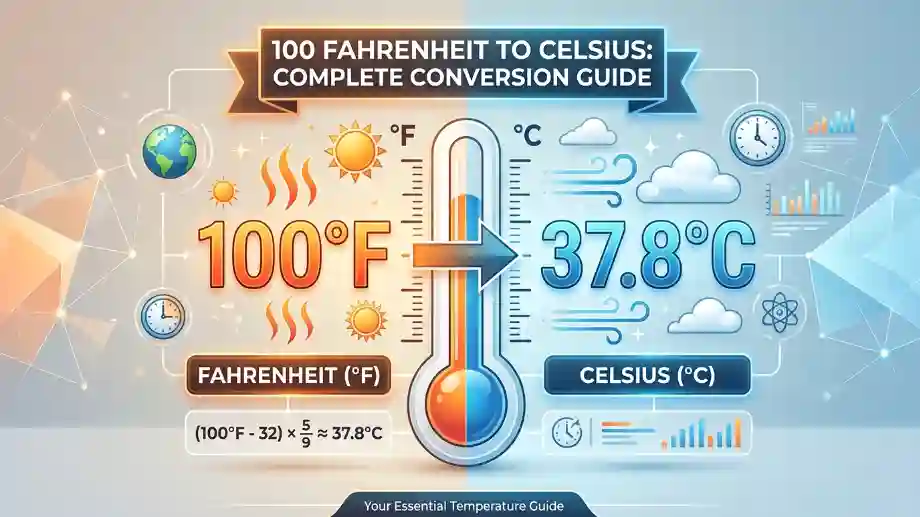
100°F = 37.78°C
This temperature is remarkably close to the average healthy human body temperature, making it one of the most commonly searched temperature conversions online.
In this comprehensive guide, you’ll learn how to convert Fahrenheit to Celsius, understand why the conversion matters, explore real-world examples, and discover practical temperature reference points that make the numbers easier to remember.
100 Fahrenheit to Celsius Conversion
Using the standard conversion formula:
°C = (°F − 32) × 5/9
Let’s calculate it step by step.
| Step | Calculation |
| Fahrenheit | 100°F |
| Subtract 32 | 100 − 32 = 68 |
| Multiply by 5 | 68 × 5 = 340 |
| Divide by 9 | 340 ÷ 9 = 37.78 |
Final Answer
100°F = 37.78°C
Rounded values:
- 37.8°C
- 38°C (approximate)
Fahrenheit to Celsius Formula
The official conversion formula is:
°C = (°F − 32) × 5/9
This formula is recognized worldwide and is used by:
- Scientists
- Meteorologists
- Medical professionals
- Engineers
- Educational institutions
It accurately converts any Fahrenheit temperature into Celsius.
Reverse Formula
To convert Celsius back to Fahrenheit:
°F = (°C × 9/5) + 32
Why Does This Conversion Matter?
Many countries use Celsius as the standard temperature scale, while the United States primarily uses Fahrenheit.
Knowing temperature conversions helps when:
- Traveling internationally
- Reading weather forecasts
- Following cooking recipes
- Understanding scientific data
- Monitoring body temperature
- Working in healthcare
- Conducting laboratory experiments
Because temperature affects health, food safety, industrial processes, and climate measurements, accurate conversion is important.
Real-World Meaning of 37.78°C
Understanding what 37.78°C actually feels like makes the number easier to remember.
Human Body Temperature
Normal body temperature is commonly considered around:
- 37°C (98.6°F)
According to medical research, healthy body temperature varies naturally between individuals and throughout the day. A reading of 37.78°C (100°F) is considered slightly elevated and may indicate a mild fever depending on age, symptoms, and measurement method.
Research published by medical institutions has shown that average body temperature is not identical for everyone and typically falls within a normal range rather than a single fixed value.
Weather Perspective
If outdoor temperatures reach:
100°F (37.78°C)
the weather is considered:
- Extremely hot
- Potentially dangerous during prolonged exposure
- Capable of increasing the risk of heat exhaustion and heatstroke
Many regions experience temperatures above 100°F during summer heat waves.
Read more guide Fahrenheit to Celsius Calculator
Comparison with Other Common Temperatures
| Fahrenheit | Celsius | Description |
| 32°F | 0°C | Freezing point of water |
| 50°F | 10°C | Cool weather |
| 68°F | 20°C | Comfortable room temperature |
| 77°F | 25°C | Warm day |
| 86°F | 30°C | Hot weather |
| 98.6°F | 37°C | Average body temperature |
| 100°F | 37.78°C | Very hot weather / mild fever range |
| 104°F | 40°C | High fever |
| 212°F | 100°C | Boiling point of water |
Understanding the Fahrenheit Scale
The Fahrenheit scale was introduced by physicist Daniel Gabriel Fahrenheit in 1724.
Key reference points include:
- Water freezes at 32°F
- Water boils at 212°F
- There are 180 degrees between freezing and boiling
Today, Fahrenheit is mainly used in:
- United States
- Some Caribbean nations
- A few U.S. territories
Understanding the Celsius Scale
The Celsius scale was developed by Anders Celsius.
It is based on:
- Water freezing at 0°C
- Water boiling at 100°C
Because of its simplicity, Celsius has become the international standard for:
- Science
- Medicine
- Weather reporting
- Engineering
- Education
Nearly every country uses Celsius for everyday temperature reporting.
Practical Examples
Example 1: Weather Forecast
Forecast:
Today’s high will reach 100°F.
Converted:
37.78°C
This indicates extremely hot conditions.
Example 2: Cooking
Some recipes reference oven temperatures differently depending on country.
Although oven temperatures are usually much higher than 100°F, understanding conversion principles helps when following international recipes.
Example 3: Medical Thermometer
A thermometer reading:
100°F
equals:
37.78°C
This may indicate a low-grade fever, though clinical interpretation depends on age, symptoms, and how the temperature was measured.
Quick Fahrenheit to Celsius Table
| Fahrenheit | Celsius |
| 90°F | 32.2°C |
| 95°F | 35°C |
| 100°F | 37.8°C |
| 105°F | 40.6°C |
| 110°F | 43.3°C |
| 115°F | 46.1°C |
| 120°F | 48.9°C |
Why Most Countries Use Celsius
Today, over 190 countries officially use Celsius because it integrates naturally with the metric system.
Advantages include:
- Easier calculations
- Scientific consistency
- Global standardization
- Simpler educational use
- International compatibility
Scientists almost universally use Celsius or Kelvin.
Common Temperature Benchmarks
Knowing a few reference temperatures makes conversions easier.
| Celsius | Fahrenheit | Meaning |
| 0°C | 32°F | Water freezes |
| 20°C | 68°F | Comfortable room |
| 25°C | 77°F | Pleasant day |
| 30°C | 86°F | Hot weather |
| 37°C | 98.6°F | Normal body temperature |
| 40°C | 104°F | High fever |
| 100°C | 212°F | Water boils |
Tips for Remembering the Conversion
You don’t always need a calculator.
Useful reference points include:
- 32°F = 0°C
- 68°F = 20°C
- 86°F = 30°C
- 98.6°F = 37°C
- 100°F ≈ 38°C
These benchmarks cover most everyday situations.
Common Mistakes to Avoid
Rounding Too Early
Perform the complete calculation before rounding.
Correct:
100°F = 37.78°C
Not simply:
100°F = 37°C
Forgetting to Subtract 32
A common mistake is multiplying directly by 5/9.
Always subtract 32 first.
Mixing Weather and Medical Temperatures
A temperature of 100°F has different implications depending on context.
- Outdoors: extremely hot weather
- Body temperature: possible mild fever
Context matters.
Scientific Importance of Accurate Temperature Conversion
Temperature conversion plays a crucial role in:
- Medical diagnostics
- Climate science
- Food safety
- Pharmaceutical manufacturing
- Engineering
- Aviation
- Chemical laboratories
International collaboration depends on standardized measurements, making accurate conversion essential across industries.
Frequently Asked Questions
What is 100 Fahrenheit in Celsius?
100°F equals 37.78°C.
Is 100°F considered a fever?
A body temperature of 100°F (37.78°C) is generally considered a low-grade fever or slightly elevated temperature in many clinical settings, but interpretation depends on age, symptoms, and measurement method.
What is the easiest way to convert Fahrenheit to Celsius?
Use the formula:
(°F − 32) × 5/9
Subtract 32 first, then multiply by 5 and divide by 9.
Why does the United States use Fahrenheit?
The United States continues using Fahrenheit largely because of historical adoption and existing infrastructure. Most other countries transitioned to Celsius during metrication efforts.
Which temperature scale is used in science?
Scientists primarily use Celsius for everyday measurements and Kelvin for scientific and thermodynamic calculations.
Is 37.78°C dangerous?
For outdoor weather, 37.78°C is very hot and can increase the risk of heat-related illness. For body temperature, it may indicate a mild fever, but the significance depends on individual circumstances.
What is the difference between Fahrenheit and Celsius?
The two scales use different reference points:
- Fahrenheit: water freezes at 32°F and boils at 212°F.
- Celsius: water freezes at 0°C and boils at 100°C.
Celsius is part of the metric system and is used by most countries.
Conclusion
Converting 100 Fahrenheit to Celsius is simple once you know the formula:
100°F = 37.78°C
This temperature is significant because it is close to normal human body temperature while also representing very hot outdoor conditions. Whether you’re interpreting weather reports, checking a thermometer, traveling abroad, or working with scientific information, understanding Fahrenheit-to-Celsius conversion helps you make informed decisions.
By remembering a few key reference points and using the standard conversion formula, you can quickly convert temperatures with confidence.
