

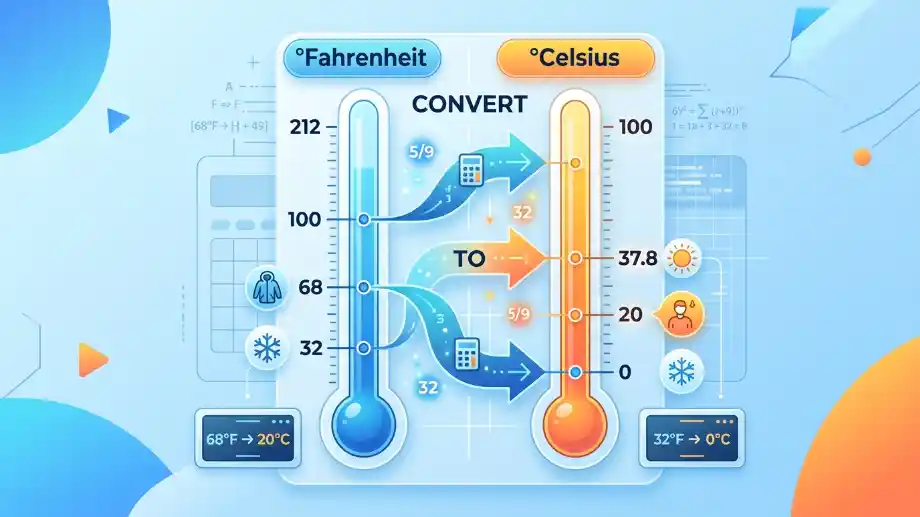
Temperature conversion is essential in everyday life, whether you’re following an international recipe, checking weather forecasts, understanding medical readings, conducting scientific experiments, or traveling abroad. Since different countries use different temperature scales, knowing how to convert Fahrenheit to Celsius can save time and prevent costly mistakes.
A Fahrenheit to Celsius Calculator makes the conversion quick, accurate, and effortless. Instead of manually applying formulas, users can instantly convert temperatures with a single input.
This comprehensive guide explains how Fahrenheit and Celsius work, the conversion formula, practical examples, common applications, and frequently asked questions to help you understand temperature conversion with confidence.
What Is a Fahrenheit to Celsius Calculator?
A Fahrenheit to Celsius Calculator is a digital tool that converts temperatures measured in degrees Fahrenheit (°F) into degrees Celsius (°C).
Rather than calculating manually, users simply enter a Fahrenheit value, and the calculator instantly provides the Celsius equivalent using the internationally accepted conversion formula.
These calculators are commonly used in:
- Weather forecasting
- Medical settings
- Cooking and baking
- Scientific research
- Engineering
- Education
- International travel
Because modern calculators eliminate manual errors, they provide reliable and consistent results.
Why Temperature Conversion Matters
Different countries use different temperature scales.
| Region | Common Temperature Scale |
| United States | Fahrenheit (°F) |
| Canada | Celsius (°C) |
| Europe | Celsius (°C) |
| Australia | Celsius (°C) |
| Asia | Celsius (°C) |
| Africa | Celsius (°C) |
Only a handful of countries primarily use Fahrenheit today, while most of the world follows the Celsius scale.
This difference makes accurate conversion increasingly important in a globalized world.
Fahrenheit vs Celsius: Understanding the Difference
Fahrenheit Scale
The Fahrenheit scale was developed by German physicist Daniel Gabriel Fahrenheit in 1724.
Key reference points include:
- Water freezes at 32°F
- Water boils at 212°F
- 180 degrees separate freezing and boiling
The United States still primarily uses this system for weather and household temperature measurements.
Celsius Scale
The Celsius scale, originally developed by Swedish astronomer Anders Celsius, is the international standard used by science and nearly every country worldwide.
Key reference points:
- Water freezes at 0°C
- Water boils at 100°C
- 100 degrees separate freezing and boiling
The Celsius scale forms the basis of the International System of Units (SI).
Fahrenheit to Celsius Formula
The standard conversion formula is:
°C = (°F − 32) × 5/9
This formula has been internationally accepted for decades and is used in scientific, educational, and engineering applications.
Read more guide: Square Meters to Square Feet: The Complete Conversion Guide
Step-by-Step Conversion Example
Suppose you want to convert 95°F.
Step 1
Subtract 32.
95 − 32 = 63
Step 2
Multiply by 5.
63 × 5 = 315
Step 3
Divide by 9.
315 ÷ 9 = 35
Answer: 95°F = 35°C
Common Fahrenheit to Celsius Conversion Table
| Fahrenheit | Celsius |
| -40°F | -40°C |
| 0°F | -17.8°C |
| 10°F | -12.2°C |
| 20°F | -6.7°C |
| 32°F | 0°C |
| 40°F | 4.4°C |
| 50°F | 10°C |
| 60°F | 15.6°C |
| 68°F | 20°C |
| 70°F | 21.1°C |
| 77°F | 25°C |
| 86°F | 30°C |
| 95°F | 35°C |
| 98.6°F | 37°C |
| 104°F | 40°C |
| 122°F | 50°C |
| 212°F | 100°C |
Everyday Uses of Fahrenheit to Celsius Conversion
Temperature conversion is useful in numerous situations.
Weather Forecasts
Travelers often need to convert temperatures when visiting countries that use Celsius.
For example:
- 86°F = 30°C
- 104°F = 40°C
Knowing these values helps people prepare appropriate clothing and plan outdoor activities.
Cooking and Baking
Many international recipes list oven temperatures in Celsius.
Examples:
| Fahrenheit | Celsius |
| 300°F | 150°C |
| 325°F | 163°C |
| 350°F | 177°C |
| 375°F | 190°C |
| 400°F | 204°C |
| 425°F | 218°C |
| 450°F | 232°C |
Incorrect conversion can affect baking quality, cooking time, and food safety.
Healthcare
Human body temperature is measured differently around the world.
Typical values include:
| Fahrenheit | Celsius |
| 97°F | 36.1°C |
| 98.6°F | 37°C |
| 100.4°F | 38°C |
| 102.2°F | 39°C |
Medical professionals frequently convert temperatures for international records and research.
Science and Education
Scientific research almost universally uses Celsius and Kelvin.
Students studying chemistry, biology, or physics regularly convert between temperature scales.
Industrial Applications
Temperature conversion is essential in:
- Manufacturing
- HVAC systems
- Chemical processing
- Food production
- Automotive engineering
- Pharmaceutical industries
Even minor conversion errors can significantly impact product quality and safety.
Benefits of Using an Online Calculator
Modern online calculators offer several advantages over manual calculations.
Instant Results
Conversions occur immediately.
Improved Accuracy
Automatic calculations eliminate arithmetic mistakes.
User-Friendly
Most calculators require only one input.
Mobile Compatibility
Users can convert temperatures on smartphones, tablets, and desktops.
Educational Value
Many calculators also display the conversion formula, helping users understand the underlying mathematics.
Manual Conversion Tips
Although calculators are convenient, understanding the formula is still valuable.
Remember these reference temperatures:
| Fahrenheit | Celsius |
| 32°F | 0°C |
| 50°F | 10°C |
| 68°F | 20°C |
| 86°F | 30°C |
| 104°F | 40°C |
| 212°F | 100°C |
Memorizing these benchmarks makes estimating temperatures much easier.
Common Temperature Conversion Mistakes
Many people make avoidable errors during manual conversion.
Forgetting to Subtract 32
Subtracting 32 is the first step.
Skipping it leads to incorrect results.
Using Incorrect Multiplication
Always multiply by 5/9, not 9/5.
The reverse ratio converts Celsius to Fahrenheit.
Rounding Too Early
Perform calculations first.
Round only after obtaining the final value for greater accuracy.
Confusing Temperature Scales
Always verify whether a measurement is expressed in Fahrenheit or Celsius before converting.
Real-World Importance of Accurate Temperature Conversion
Accurate temperature conversion supports many industries.
Examples include:
- Weather forecasting
- Aviation
- Climate science
- Food safety
- Medical diagnostics
- Pharmaceutical manufacturing
- Laboratory testing
For example, global weather organizations typically publish temperatures in Celsius, while American weather reports use Fahrenheit. International collaboration depends on precise conversion.
Likewise, the food industry relies on accurate cooking temperatures to meet food safety standards. Improper conversion can lead to undercooked or overcooked food.
Research and Standards
The Celsius scale is the standard temperature scale used by the International System of Units (SI), making it the preferred choice in scientific research worldwide.
Organizations such as national meteorological agencies, public health institutions, and standards bodies use standardized temperature conversion methods to ensure consistency across international datasets, laboratory measurements, and engineering processes.
Additionally, weather agencies worldwide report millions of temperature observations daily using Celsius, while international scientific publications almost exclusively present temperature data in Celsius or Kelvin.
Who Should Use a Fahrenheit to Celsius Calculator?
This conversion tool is useful for:
- Students
- Teachers
- Scientists
- Engineers
- Healthcare professionals
- Travelers
- Home cooks
- Bakers
- Meteorologists
- Researchers
- HVAC technicians
- Industrial workers
Its simplicity makes it suitable for both professionals and everyday users.
Frequently Asked Questions
How do I convert Fahrenheit to Celsius?
Use the formula:
°C = (°F − 32) × 5/9
Subtract 32 from the Fahrenheit temperature, multiply by 5, and divide by 9.
Why do most countries use Celsius?
Celsius is simpler because water freezes at 0°C and boils at 100°C. It is also the internationally recognized standard used in science and most countries.
What is normal body temperature in Celsius?
Normal body temperature is approximately 37°C, which equals 98.6°F.
What is room temperature in Celsius?
Typical room temperature ranges between 20°C and 22°C (68°F to 72°F).
What is 100°F in Celsius?
100°F equals 37.8°C.
Is Celsius more accurate than Fahrenheit?
Neither scale is inherently more accurate. Both measure the same physical property. The difference lies in the size of their degree intervals and where they are commonly used.
Can I estimate Fahrenheit to Celsius without a calculator?
Yes. A quick estimate is to subtract 30 from the Fahrenheit value and divide by 2. While convenient, this method is only approximate and less accurate than using the standard formula.
Why do scientists use Celsius instead of Fahrenheit?
Scientists prefer Celsius because it aligns with the metric system and directly relates to the Kelvin scale, which is the SI base unit for temperature.
Conclusion
A Fahrenheit to Celsius Calculator is an indispensable tool for anyone who needs fast, accurate temperature conversions. Whether you’re planning international travel, following a recipe, monitoring body temperature, or working in science or engineering, understanding how Fahrenheit converts to Celsius helps ensure accuracy and consistency.
While the conversion formula is straightforward, online calculators eliminate the risk of manual errors and save valuable time. Combined with a basic understanding of the two temperature scales, they make interpreting temperatures from around the world simple and reliable.
