

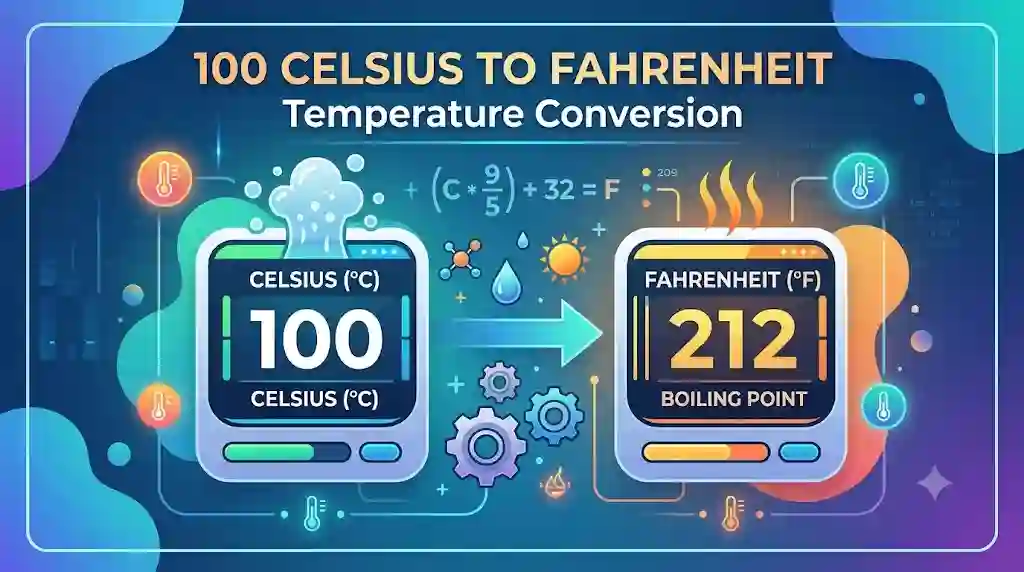
Temperature conversion is one of the most common calculations people perform, whether they’re following an international recipe, conducting a science experiment, traveling abroad, or studying physics. If you’ve ever wondered how to convert 100 Celsius to Fahrenheit, the answer is simple:
100°C = 212°F
While this conversion appears straightforward, understanding why it works and when it matters can help you avoid mistakes in cooking, scientific measurements, weather interpretation, and industrial applications.
This comprehensive guide explains the Celsius-to-Fahrenheit formula, demonstrates step-by-step calculations, provides practical examples, and answers frequently asked questions. By the end, you’ll understand not only the conversion but also the relationship between the world’s two most widely used temperature scales.
Understanding Celsius and Fahrenheit
Before converting temperatures, it’s helpful to understand the two scales.
What Is the Celsius Scale?
The Celsius scale (°C), formerly known as the centigrade scale, is the international standard for measuring temperature. It is used by nearly every country worldwide and is the official temperature scale in the International System of Units (SI).
On the Celsius scale:
- Water freezes at 0°C
- Water boils at 100°C under standard atmospheric pressure (1 atmosphere)
- Human body temperature averages around 37°C
Because of its decimal-based design, Celsius is widely used in:
- Science
- Medicine
- Engineering
- Weather forecasting
- Education
What Is the Fahrenheit Scale?
The Fahrenheit scale (°F) is primarily used in the United States and a few territories.
Key reference points include:
- Water freezes at 32°F
- Water boils at 212°F
- Average human body temperature is approximately 98.6°F
Although less common internationally, Fahrenheit remains important for:
- U.S. weather reports
- Household thermostats
- Cooking instructions
- Industrial equipment in America
100 Celsius to Fahrenheit Conversion
The exact conversion is:
| Celsius | Fahrenheit |
| 100°C | 212°F |
Therefore:
100 degrees Celsius equals 212 degrees Fahrenheit.
This is one of the most widely recognized temperature conversions because it represents the boiling point of pure water at standard atmospheric pressure.
Celsius to Fahrenheit Formula
The conversion formula is:
°F = (°C × 9/5) + 32
Let’s calculate the conversion step by step.
Step 1
Multiply Celsius by 9.
100 × 9 = 900
Step 2
Divide by 5.
900 ÷ 5 = 180
Step 3
Add 32.
180 + 32 = 212°F
Final Answer:
100°C = 212°F
Why Does Water Boil at 100°C and 212°F?
One reason 100 Celsius to Fahrenheit is such a common search is because it represents the boiling point of water.
At standard atmospheric pressure:
| Property | Celsius | Fahrenheit |
| Freezing point | 0°C | 32°F |
| Boiling point | 100°C | 212°F |
These temperatures are scientifically defined reference points used worldwide.
However, boiling temperature changes with atmospheric pressure:
- Higher elevations lower the boiling point.
- Pressure cookers increase boiling temperature.
- Industrial processes often operate under controlled pressure.
For example:
- At sea level: 100°C (212°F)
- On high mountains: Water may boil below 100°C.
Practical Uses of This Conversion
Knowing this conversion is useful in many situations.
1. Cooking and Baking
Recipes from different countries often use different temperature units.
Example:
A European recipe may state:
Boil water to 100°C
An American cook understands this as:
212°F
Similarly, oven temperatures often require conversion between Celsius and Fahrenheit.
2. Science Education
Laboratory experiments frequently use Celsius because it aligns with SI standards.
Students in countries using Fahrenheit often convert temperatures when reading research papers or textbooks.
Examples include:
- Chemistry
- Biology
- Environmental science
- Medical research
3. International Travel
Travelers moving between countries frequently encounter different temperature scales.
Although weather rarely reaches 100°C, understanding the conversion system helps interpret:
- Hotel appliances
- Kitchen equipment
- Industrial warnings
- Laboratory instruments
4. Engineering
Engineers frequently convert temperatures when:
- Designing heating systems
- Testing materials
- Monitoring industrial processes
- Manufacturing products
Accurate conversion prevents costly errors.
Common Celsius to Fahrenheit Conversions
The table below shows frequently used conversions.
| Celsius | Fahrenheit |
| 0°C | 32°F |
| 10°C | 50°F |
| 20°C | 68°F |
| 25°C | 77°F |
| 30°C | 86°F |
| 37°C | 98.6°F |
| 40°C | 104°F |
| 50°C | 122°F |
| 75°C | 167°F |
| 80°C | 176°F |
| 90°C | 194°F |
| 100°C | 212°F |
| 120°C | 248°F |
| 150°C | 302°F |
| 180°C | 356°F |
| 200°C | 392°F |
This table is particularly useful for cooking and educational purposes.
Reverse Formula: Fahrenheit to Celsius
To convert Fahrenheit back to Celsius:
°C = (°F − 32) × 5/9
Example:
212°F
Subtract 32:
212 − 32 = 180
Multiply by 5:
180 × 5 = 900
Divide by 9:
900 ÷ 9 = 100
Result:
212°F = 100°C
The History Behind These Temperature Scales
Celsius
The Celsius scale was introduced by Swedish astronomer Anders Celsius in 1742. It was later standardized into the modern scale used today.
Its simple decimal intervals made it ideal for scientific work.
Fahrenheit
The Fahrenheit scale was created by physicist Daniel Gabriel Fahrenheit in 1724.
His scale became widely adopted in English-speaking countries before Celsius gained international acceptance.
Today:
- Most countries use Celsius.
- The United States primarily uses Fahrenheit.
Why Scientists Prefer Celsius
Most scientific organizations use Celsius because it integrates seamlessly with the metric system.
Advantages include:
- Decimal-based measurements
- Easier calculations
- International consistency
- Compatibility with SI units
Scientific journals, laboratories, and universities generally report temperatures in Celsius or Kelvin.
Common Conversion Mistakes
Many people make simple arithmetic errors.
Avoid these mistakes:
Forgetting to Add 32
Incorrect:
100 × 9/5 = 180°F
Correct:
180 + 32 = 212°F
Reversing the Formula
The Celsius-to-Fahrenheit formula differs from the Fahrenheit-to-Celsius formula.
Always verify which direction you’re converting.
Assuming Equal Intervals
Although both scales measure temperature, they use different interval sizes.
- One Celsius degree equals 1.8 Fahrenheit degrees.
- This explains why conversions require multiplication.
Real-World Applications
Temperature conversion plays an essential role across industries.
Healthcare
Medical professionals compare body temperatures using different scales.
For example:
- 37°C = 98.6°F
- 38°C = 100.4°F
Manufacturing
Factories monitor temperatures during:
- Metal processing
- Food production
- Plastic molding
- Pharmaceutical manufacturing
Even small conversion errors can affect product quality.
Weather
Nearly every country reports temperatures in Celsius, while the United States uses Fahrenheit.
Meteorologists, travelers, and international businesses regularly convert between the two systems.
Food Safety
Food safety agencies recommend cooking foods to specific internal temperatures. Whether instructions are given in Celsius or Fahrenheit, accurate conversion helps ensure food is cooked safely.
Quick Mental Conversion Tips
For everyday estimates:
- Double the Celsius value.
- Add 30.
Example:
100°C
100 × 2 = 200
200 + 30 ≈ 230°F
This estimate is close but not exact.
For precision, always use:
°F = (°C × 9/5) + 32
Frequently Asked Questions
Is 100°C exactly 212°F?
Yes.
At standard atmospheric pressure:
100°C = 212°F
This is an exact conversion.
Why is water’s boiling point important?
The boiling point serves as one of the primary calibration references for thermometers and scientific measurements.
Is water always boiling at 100°C?
No.
Water boils at 100°C only at standard atmospheric pressure.
At higher elevations, the boiling point decreases because atmospheric pressure is lower.
Which countries use Fahrenheit?
The United States is the primary country that uses Fahrenheit for everyday weather reporting. A few Caribbean nations and U.S. territories also use it in certain contexts.
Why does science use Celsius?
Celsius aligns with the metric system, making calculations simpler and ensuring international consistency in research and education.
Can I estimate Celsius to Fahrenheit without a calculator?
Yes.
For a rough estimate:
- Multiply by 2.
- Add 30.
For exact results, use:
°F = (°C × 9/5) + 32
What is the freezing point of water?
- Celsius: 0°C
- Fahrenheit: 32°F
Is 212°F always equal to 100°C?
Yes.
These values are mathematically equivalent under the standard conversion formula.
Conclusion
Converting 100 Celsius to Fahrenheit is straightforward once you understand the formula. The exact conversion is 212°F, which also represents the boiling point of pure water at standard atmospheric pressure. Whether you’re following an international recipe, conducting scientific research, studying for an exam, or working in engineering, knowing how to convert between Celsius and Fahrenheit is a practical and valuable skill.
Beyond memorizing the answer, understanding the relationship between the two temperature scales helps improve accuracy in everyday tasks and professional settings. Keeping the conversion formula handy—or remembering a few common reference points—can save time and reduce mistakes.
