

Height measurements are used every day for medical records, passport applications, sports, clothing sizes, and fitness tracking. However, different countries use different measurement systems. While the United States commonly measures height in feet and inches, most of the world uses the metric system, where height is recorded in centimeters (cm).
If you’ve ever wondered 5 Feet 10 Inches in CM, the answer is simple:
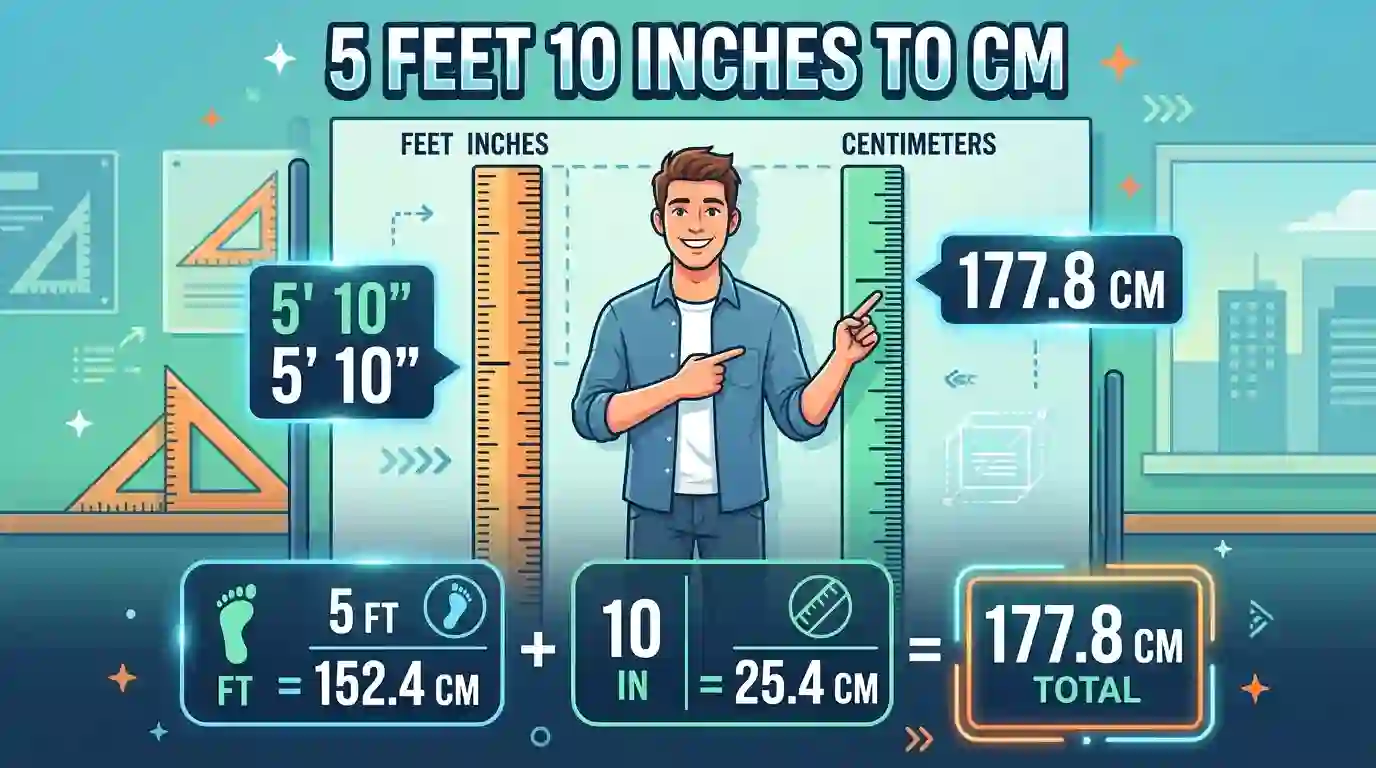
5 feet 10 inches = 177.8 centimeters (cm)
This conversion is internationally accepted and widely used in healthcare, education, aviation, sports, and official documentation.
In this comprehensive guide, you’ll learn how to convert feet and inches into centimeters, understand the math behind the conversion, compare this height globally, and discover where this measurement is commonly used.
What Is 5 Feet 10 Inches in CM?
The exact conversion is:
| Height | Centimeters |
| 5 feet 10 inches | 177.8 cm |
Since one inch equals 2.54 centimeters, converting height becomes straightforward once you know the formula.
Most official records round this value to:
- 177.8 cm (precise)
- 178 cm (rounded)
Both are generally acceptable depending on the context.
How to Convert 5 Feet 10 Inches to Centimeters
The conversion follows a simple process.
Step 1: Convert Feet to Inches
5 feet =
5 × 12 = 60 inches
Step 2: Add Remaining Inches
60 + 10 = 70 inches
Step 3: Convert Inches to Centimeters
70 × 2.54 =
177.8 cm
Final Answer
5 feet 10 inches = 177.8 centimeters
Conversion Formula
Use this formula for any height:
Centimeters = (Feet × 12 + Inches) × 2.54
Example:
- Feet = 5
- Inches = 10
Calculation:
(5 × 12 + 10) × 2.54
= 70 × 2.54
= 177.8 cm
This is the internationally recognized conversion method.
Quick Height Conversion Table
| Feet & Inches | Centimeters |
| 5’6″ | 167.6 cm |
| 5’7″ | 170.2 cm |
| 5’8″ | 172.7 cm |
| 5’9″ | 175.3 cm |
| 5’10” | 177.8 cm |
| 5’11” | 180.3 cm |
| 6’0″ | 182.9 cm |
| 6’1″ | 185.4 cm |
| 6’2″ | 188.0 cm |
This chart helps compare nearby height measurements quickly.
Why Height Conversion Matters
Converting between imperial and metric units is important because different countries use different systems.
Common situations include:
- Medical examinations
- Passport applications
- Visa documentation
- Military recruitment
- International sports competitions
- Online clothing shopping
- BMI calculations
- Health records
- Driver’s licenses
- University admissions
Incorrect conversions can create confusion in official paperwork.
Which Countries Use Feet and Inches?
The imperial system remains common in:
- United States
- Parts of Canada
- United Kingdom (informally)
Most other countries—including those in Europe, Asia, Australia, Africa, and South America—use centimeters for recording height.
This makes accurate conversion especially useful for international travel and documentation.
Is 177.8 cm Considered Tall?
Whether a height is considered tall depends on the country and population.
Generally speaking:
- For men, 177.8 cm is around average to slightly above average in many countries.
- For women, this height is considered significantly above average in most populations.
According to health organizations and demographic studies, average adult male height varies worldwide, ranging from roughly 165 cm to 183 cm, depending on genetics, nutrition, and region.
Height Comparison Chart
| Height | Comparison |
| 160 cm | Short |
| 165 cm | Below average |
| 170 cm | Average in many countries |
| 175 cm | Slightly above average |
| 177.8 cm | Above average in many regions |
| 180 cm | Tall |
| 185 cm | Very tall |
These are broad comparisons and vary by country and sex.
Understanding the Metric System
The metric system is used by over 95% of the world’s population and is the international standard for science, medicine, engineering, and education.
Key conversions include:
| Unit | Equivalent |
| 1 inch | 2.54 cm |
| 12 inches | 1 foot |
| 100 cm | 1 meter |
| 1 meter | 100 cm |
Because the metric system is decimal-based, it is generally easier for calculations than the imperial system.
Common Height Conversions
| Feet | Centimeters |
| 5’0″ | 152.4 cm |
| 5’2″ | 157.5 cm |
| 5’4″ | 162.6 cm |
| 5’5″ | 165.1 cm |
| 5’8″ | 172.7 cm |
| 5’10” | 177.8 cm |
| 6’0″ | 182.9 cm |
| 6’3″ | 190.5 cm |
Practical Examples
Example 1: Medical Records
A patient reports being 5 feet 10 inches tall.
The hospital records this as:
177.8 cm
Example 2: Sports Registration
Many international sporting organizations require athlete heights in centimeters.
An athlete measuring 5’10” would register as:
177.8 cm
Example 3: Passport Application
Some passport forms request height in centimeters.
Instead of writing 5’10”, applicants should enter:
178 cm (or 177.8 cm if decimals are accepted)
Example 4: Online Shopping
Many clothing retailers use centimeters for sizing.
Knowing your metric height helps select jackets, suits, and sportswear more accurately.
Height and Body Mass Index (BMI)
BMI uses height in meters.
177.8 cm converts to:
1.778 meters
BMI Formula:
BMI = Weight (kg) ÷ Height² (m²)
Example:
Weight = 75 kg
Height = 1.778 m
BMI =
75 ÷ (1.778 × 1.778)
≈ 23.7
This falls within the healthy BMI range for most adults.
Manual Conversion vs Online Converters
You can convert heights manually or use digital tools.
Manual Method
Advantages:
- No internet needed
- Accurate
- Easy after learning the formula
Online Converter
Advantages:
- Instant results
- Reduces calculation errors
- Useful for frequent conversions
Both methods rely on the same standard conversion factor of 2.54 centimeters per inch.
Common Mistakes When Converting Height
People often make simple conversion errors.
These include:
- Forgetting that one foot equals 12 inches.
- Multiplying feet directly by 2.54.
- Ignoring the additional inches.
- Rounding too early.
- Mixing centimeters and meters.
Following the standard formula avoids these mistakes.
Why 2.54 Centimeters per Inch?
The conversion factor of 2.54 cm per inch has been internationally standardized since 1959, when English-speaking countries agreed on a common definition of the inch based on the metric system. This standard ensures consistency in engineering, manufacturing, science, and international trade.
Frequently Asked Questions
Is 5 feet 10 inches exactly 178 cm?
Not exactly.
The precise conversion is:
177.8 cm
It is commonly rounded to 178 cm for convenience.
How many inches are in 5 feet 10 inches?
There are:
70 inches
Calculation:
(5 × 12) + 10 = 70
Is 177.8 cm a good height?
Height preferences vary, but 177.8 cm is considered average to above average for adult men in many countries and tall for most adult women.
Can I round 177.8 cm to 178 cm?
Yes.
Most official forms accept rounded values unless they specifically require decimal precision.
What is 177.8 cm in meters?
177.8 cm equals:
1.778 meters
Why do some countries use feet instead of centimeters?
Countries such as the United States continue to use the imperial system in everyday life, while most other nations have adopted the metric system for standard measurements.
How accurate is the conversion?
The conversion is exact because:
1 inch = 2.54 centimeters
This international standard is used worldwide.
Can height change during the day?
Yes. Adults are typically 1–2 cm taller in the morning than in the evening because the spinal discs compress slightly throughout the day under the effects of gravity.
Conclusion
Converting 5 Feet 10 Inches in CM is simple once you understand the formula. The exact conversion is 177.8 centimeters, which is often rounded to 178 cm for everyday use. This measurement is recognized internationally and is suitable for medical records, travel documents, fitness tracking, sports registrations, and clothing size guides.
Understanding both imperial and metric units makes it easier to communicate measurements across countries and ensures accuracy in official and professional settings. Whether you’re completing paperwork, shopping online, or monitoring your health, knowing the correct conversion helps you avoid errors and compare measurements confidently.
