

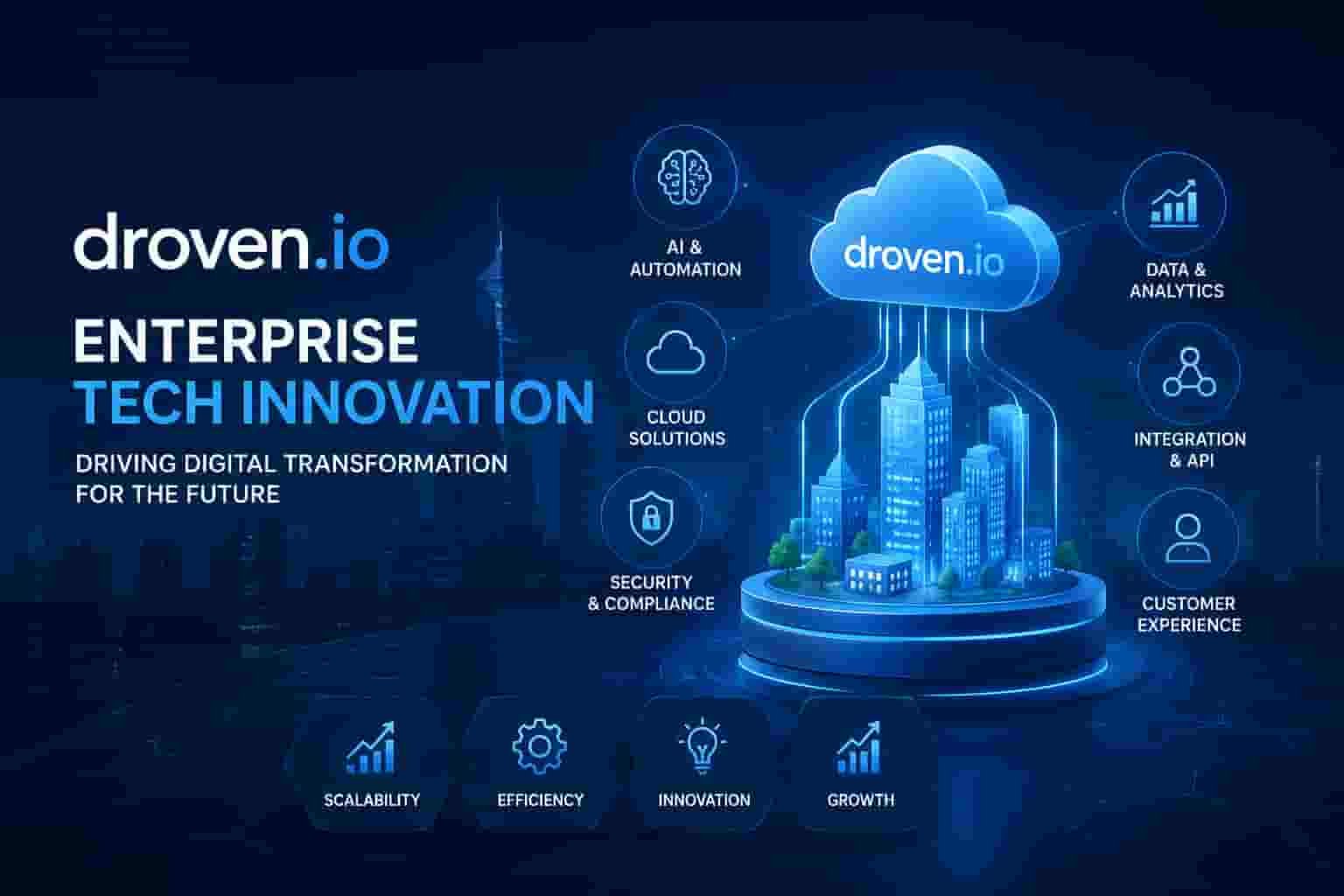
Enterprise technology is evolving faster than ever. Organizations are under constant pressure to modernize infrastructure, adopt artificial intelligence, strengthen cybersecurity, reduce operational costs, and deliver better customer experiences.
Droven.io enterprise tech innovation represents this new generation of enterprise modernization by focusing on scalable technology solutions, cloud-first architecture, intelligent automation, data-driven decision-making, and innovation strategies that help businesses remain competitive.
Whether you’re a business leader, IT manager, startup founder, or digital transformation consultant, understanding droven.io enterprise tech innovation can help you identify emerging enterprise technology trends, evaluate modernization strategies, and build a future-ready organization.
This comprehensive guide explains what it is, why it matters, best practices, implementation strategies, common mistakes, and how organizations can maximize technology investments.
Key Takeaways
Quick Summary
Droven.io enterprise tech innovation refers to enterprise-focused technology modernization that combines cloud computing, AI, automation, cybersecurity, analytics, and scalable digital infrastructure to improve operational efficiency, business agility, and long-term growth.
In this guide you’ll learn:
- What droven.io enterprise tech innovation means
- Core enterprise technology pillars
- Digital transformation best practices
- AI and automation strategies
- Cloud modernization approaches
- Cybersecurity considerations
- Enterprise implementation roadmap
- Common mistakes to avoid
- Expert recommendations
- Frequently asked questions
What Is Droven.io Enterprise Tech Innovation?
Droven.io enterprise tech innovation describes a modern approach to enterprise technology that emphasizes continuous innovation rather than one-time digital transformation projects.
Instead of simply replacing legacy systems, organizations adopting this philosophy typically focus on creating an agile technology ecosystem that enables continuous improvement.
Core objectives include:
- Faster innovation cycles
- Better customer experiences
- Improved operational efficiency
- Smarter data utilization
- Stronger cybersecurity
- Scalable cloud infrastructure
- AI-driven decision making
- Automation across business processes
Rather than viewing technology as a support function, enterprise innovation treats technology as a strategic business advantage.
Why Droven.io Enterprise Tech Innovation Matters
Today’s businesses face increasing pressure from:
- Rising customer expectations
- Global competition
- Cybersecurity threats
- Rapid AI adoption
- Economic uncertainty
- Increasing operational costs
- Remote and hybrid work environments
Organizations that fail to modernize often struggle with:
- Slow software development
- Legacy infrastructure
- High maintenance costs
- Data silos
- Poor customer experiences
- Reduced productivity
Enterprise technology innovation helps address these challenges through modern platforms and intelligent automation.
The Core Pillars of Droven.io Enterprise Tech Innovation
1. Cloud-First Infrastructure
Modern enterprises increasingly migrate workloads to cloud environments because they offer:
- Elastic scalability
- Reduced infrastructure costs
- Higher availability
- Disaster recovery
- Faster deployment
- Global accessibility
Cloud-native applications also improve agility by allowing organizations to scale resources on demand.
Best Practice
Use hybrid or multi-cloud strategies when regulatory, performance, or vendor diversification requirements exist.
2. Artificial Intelligence and Machine Learning
AI has become a major driver of enterprise innovation.
Common enterprise AI use cases include:
| Business Area | AI Application |
| Customer Service | AI chatbots |
| Finance | Fraud detection |
| HR | Resume screening |
| Marketing | Personalization |
| Operations | Predictive maintenance |
| Sales | Forecasting |
| Manufacturing | Quality inspection |
Businesses using AI responsibly often experience faster decision-making and increased productivity.
3. Intelligent Automation
Automation goes beyond repetitive tasks.
Modern automation combines:
- Robotic Process Automation (RPA)
- AI
- Workflow automation
- Business process orchestration
- Intelligent document processing
Examples include:
- Invoice processing
- Employee onboarding
- Purchase approvals
- Customer support workflows
- Compliance reporting
Automation reduces manual work while improving accuracy.
How Droven.io Enterprise Tech Innovation Improves Business Performance
Organizations typically see improvements across multiple areas.
Operational Efficiency
Benefits include:
- Reduced manual processes
- Faster workflows
- Lower operational costs
- Better collaboration
Customer Experience
Technology innovation enables:
- Faster support
- Personalized experiences
- Omnichannel communication
- Real-time engagement
Satisfied customers are more likely to remain loyal and recommend your business.
Better Decision-Making
Modern analytics platforms provide:
- Real-time dashboards
- Predictive analytics
- Executive reporting
- Data visualization
- Business intelligence
Leaders can make informed decisions based on reliable data instead of assumptions.
Droven.io Enterprise Tech Innovation and Digital Transformation
Although the terms are closely related, they are not identical.
| Digital Transformation | Enterprise Tech Innovation |
| Project-based | Continuous improvement |
| Focus on modernization | Focus on innovation |
| Technology replacement | Business value creation |
| Short-term roadmap | Long-term strategy |
| System migration | Enterprise evolution |
Innovation becomes an ongoing capability rather than a single initiative.
Step-by-Step Guide to Implementing Droven.io Enterprise Tech Innovation
Step 1: Assess Current Technology
Evaluate:
- Legacy systems
- Infrastructure
- Applications
- Security posture
- Technical debt
- Data quality
Create a complete technology inventory.
Step 2: Define Business Objectives
Technology should support measurable goals such as:
- Revenue growth
- Customer satisfaction
- Cost reduction
- Operational efficiency
- Employee productivity
Avoid implementing technology without a clear business purpose.
Step 3: Prioritize High-Impact Projects
Start with initiatives that deliver quick wins, such as:
- Workflow automation
- Cloud migration
- CRM modernization
- Customer self-service
- Business intelligence dashboards
Quick successes help build organizational support.
Step 4: Build a Modern Data Foundation
Quality data powers:
- AI
- Analytics
- Automation
- Reporting
- Forecasting
Focus on:
- Data governance
- Data integration
- Security
- Compliance
- Master data management
Step 5: Strengthen Cybersecurity
Enterprise innovation must include security from the beginning.
Adopt:
- Zero Trust principles
- Multi-factor authentication
- Encryption
- Identity management
- Continuous monitoring
- Security awareness training
Security should be integrated into every technology initiative rather than added later.
Step 6: Measure Success
Track KPIs such as:
- Customer satisfaction
- ROI
- Deployment frequency
- Mean time to recovery
- Employee productivity
- Automation rate
- Infrastructure costs
Continuous measurement supports ongoing optimization.
Benefits of Droven.io Enterprise Tech Innovation
Business Benefits
- Higher productivity
- Reduced operating costs
- Faster innovation
- Improved customer satisfaction
- Better collaboration
- Increased scalability
IT Benefits
- Modern infrastructure
- Easier maintenance
- Reduced technical debt
- Improved monitoring
- Better system reliability
Financial Benefits
- Better ROI
- Lower infrastructure costs
- Reduced downtime
- More efficient resource allocation
Competitive Benefits
Businesses become more capable of:
- Launching products faster
- Responding to market changes
- Adopting emerging technologies
- Scaling globally
Emerging Technologies Supporting Enterprise Innovation
Several technologies complement droven.io enterprise tech innovation strategies.
Generative AI
Organizations use generative AI for:
- Content creation
- Software development assistance
- Knowledge management
- Customer support
- Internal search
Edge Computing
Useful for:
- Manufacturing
- Retail
- Healthcare
- Logistics
- Smart cities
Edge computing reduces latency by processing data closer to its source.
Internet of Things (IoT)
IoT enables:
- Asset monitoring
- Predictive maintenance
- Supply chain visibility
- Smart facilities
Low-Code Development
Low-code platforms help organizations:
- Develop applications faster
- Reduce backlog
- Empower citizen developers
- Accelerate innovation
Common Challenges
Organizations frequently encounter:
Legacy Systems
Older applications often lack integration capabilities.
Solution
Use APIs and phased modernization instead of replacing everything at once.
Employee Resistance
Technology adoption can fail if employees are not engaged.
Solution
Invest in:
- Training
- Communication
- Change management
- Executive sponsorship
Data Silos
Disconnected systems reduce the value of analytics.
Solution
Implement centralized data integration and governance.
Common Mistakes to Avoid
Many digital transformation initiatives struggle because organizations make avoidable errors.
Avoid these mistakes:
- Treating technology as the goal rather than a business enabler
- Ignoring employee training
- Skipping cybersecurity planning
- Migrating everything at once
- Underestimating data quality issues
- Failing to define measurable KPIs
- Neglecting governance and compliance
- Choosing tools without stakeholder input
Addressing these issues early improves adoption and long-term success.
Expert Tips for Successful Enterprise Innovation
Drawing from common enterprise modernization practices, consider the following:
Focus on Business Outcomes
Every technology investment should solve a measurable business problem.
Modernize Incrementally
Large “big bang” migrations carry higher risk. Deliver value through phased implementations.
Invest in Skills
Technology succeeds when people know how to use it effectively.
Prioritize:
- Cloud skills
- AI literacy
- Security awareness
- Agile methodologies
- Data analysis
Build for Scalability
Choose platforms that can grow with your business instead of requiring frequent replacement.
Measure Everything
Use dashboards to monitor:
- User adoption
- Performance
- Cost savings
- Customer experience
- Operational efficiency
Data-driven optimization should be continuous.
Real-World Example
Imagine a mid-sized manufacturing company relying on aging, on-premises systems. After adopting a cloud-first architecture, integrating AI for predictive maintenance, automating procurement workflows, and consolidating reporting into a unified analytics platform, it experiences fewer equipment failures, faster purchasing cycles, and improved visibility into operations. While actual outcomes vary by organization, this illustrates how combining modernization initiatives can deliver measurable business value when aligned with clear objectives.
People Also Ask
What is droven.io enterprise tech innovation?
Answer (Featured Snippet):
Droven.io enterprise tech innovation refers to a modern approach to enterprise technology that combines cloud computing, AI, automation, cybersecurity, analytics, and scalable digital infrastructure to improve business efficiency, innovation, and long-term growth.
Why is enterprise technology innovation important?
Answer (Featured Snippet):
Enterprise technology innovation helps organizations reduce costs, improve customer experiences, increase operational efficiency, strengthen cybersecurity, and respond more quickly to changing market conditions through modern digital solutions.
How does AI support enterprise innovation?
Answer (Featured Snippet):
AI improves enterprise innovation by automating repetitive tasks, analyzing large datasets, predicting trends, enhancing customer support, detecting fraud, and enabling faster, more informed business decisions.
What are the biggest barriers to digital transformation?
Answer (Featured Snippet):
The most common barriers include legacy systems, employee resistance, poor data quality, inadequate cybersecurity, limited executive support, unclear goals, and insufficient change management.
Frequently Asked Questions
1. What does droven.io enterprise tech innovation focus on?
It focuses on helping organizations modernize technology through cloud adoption, AI, automation, cybersecurity, data analytics, and scalable digital infrastructure that supports long-term business growth.
2. Is enterprise innovation only for large companies?
No. Small and medium-sized businesses can also benefit by adopting scalable cloud services, automating routine tasks, and using analytics to make better decisions.
3. How long does enterprise modernization usually take?
Timelines vary depending on the organization’s size, complexity, and objectives. Many successful programs deliver incremental improvements over months while continuing to evolve over several years.
4. Does AI replace employees?
Generally, AI is most effective when it augments human work rather than replacing it. It can automate repetitive tasks, allowing employees to focus on higher-value activities that require creativity, judgment, and collaboration.
5. What technologies are most important?
Key technologies include:
- Cloud computing
- Artificial intelligence
- Cybersecurity
- Automation
- Analytics
- APIs
- IoT
- Low-code development
6. How can businesses measure innovation success?
Measure business outcomes such as cost savings, customer satisfaction, employee productivity, system uptime, deployment frequency, revenue growth, and return on technology investment.
7. What role does cybersecurity play in enterprise innovation?
Cybersecurity is foundational. Embedding security into every stage of planning, development, deployment, and operations helps protect data, maintain compliance, and build stakeholder trust while enabling innovation.
Conclusion
Droven.io enterprise tech innovation is best understood as a strategic approach to enterprise modernization that combines cloud technologies, AI, automation, cybersecurity, and data-driven decision-making to create more agile and resilient organizations. Rather than viewing innovation as a one-time project, businesses should build repeatable capabilities that continuously improve operations and customer experiences.
Organizations that align technology investments with measurable business goals, strengthen governance, and invest in people alongside platforms are better positioned to adapt to changing markets and emerging technologies.
