

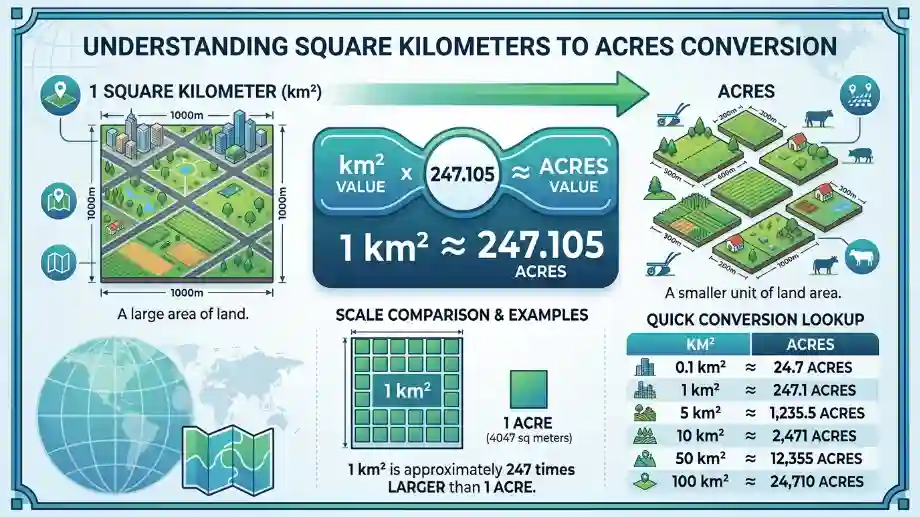
Land measurement is essential in agriculture, construction, environmental management, urban planning, and real estate. While many countries use the metric system, others commonly use acres when describing land size. As a result, converting Square Kilometers to Acres is a frequent requirement for professionals, students, landowners, and property buyers.
Understanding this conversion helps avoid costly mistakes when comparing property sizes, interpreting government records, reading international reports, or evaluating agricultural land.
This guide explains the conversion formula, provides accurate examples, includes practical applications, and answers common questions so you can confidently convert land measurements.
What Is a Square Kilometer?
A square kilometer (km²) is a metric unit used to measure area.
It represents the area of a square where each side measures exactly one kilometer.
One square kilometer equals:
- 1,000,000 square meters
- 100 hectares
- 247.105 acres
- 0.3861 square miles
Square kilometers are commonly used to measure:
- Cities
- National parks
- Forests
- Agricultural regions
- Lakes
- Countries
Government agencies, mapping organizations, and scientific researchers frequently use square kilometers because they are ideal for measuring large areas.
What Is an Acre?
An acre is an imperial and U.S. customary unit of land area.
Historically, an acre represented the amount of land that could be plowed by one yoke of oxen in one day. Today, it has a precise international definition.
One acre equals:
- 43,560 square feet
- 4,046.856 square meters
- 0.404686 hectares
- 0.0015625 square miles
Acres are widely used in:
- Real estate
- Farming
- Ranching
- Forestry
- Land sales
- Property taxation
Countries including the United States and, in many practical contexts, the United Kingdom continue to use acres for land transactions.
Square Kilometers to Acres Formula
The conversion is straightforward.
Formula:
Acres = Square Kilometers × 247.105381
This conversion factor comes from internationally accepted definitions of metric and imperial units.
Quick Formula
Acres = km² × 247.105381
Reverse Formula
Square Kilometers = Acres ÷ 247.105381
Conversion Table
| Square Kilometers | Acres |
| 0.01 | 2.471 |
| 0.05 | 12.355 |
| 0.10 | 24.711 |
| 0.25 | 61.776 |
| 0.50 | 123.553 |
| 1 | 247.105 |
| 2 | 494.211 |
| 5 | 1,235.527 |
| 10 | 2,471.054 |
| 25 | 6,177.635 |
| 50 | 12,355.269 |
| 100 | 24,710.538 |
| 500 | 123,552.691 |
| 1,000 | 247,105.381 |
Step-by-Step Conversion Examples
Example 1
Convert 3 km².
Calculation:
3 × 247.105381
= 741.316 acres
Answer: 741.32 acres
Example 2
Convert 12.5 km².
Calculation:
12.5 × 247.105381
= 3,088.82 acres
Answer: 3,088.82 acres
Example 3
Convert 0.75 km².
Calculation:
0.75 × 247.105381
= 185.33 acres
Answer: 185.33 acres
Example 4
Convert 250 km².
Calculation:
250 × 247.105381
= 61,776.35 acres
Answer: 61,776.35 acres
READ MORE: 10000 Seconds in Minutes: Complete Conversion Guide
Why This Conversion Matters
Knowing how to convert between metric and imperial land units is valuable across many industries.
Real Estate
International investors often compare land listings from countries using different measurement systems.
For example, a property advertised as 8 km² may need to be expressed in acres for buyers more familiar with imperial units.
Agriculture
Farm sizes are frequently reported differently depending on the country.
Agricultural economists and land managers regularly convert between hectares, acres, and square kilometers to compare production capacity.
Forestry
Forest management organizations monitor timber resources across vast regions measured in square kilometers while timber sales may reference acres.
Environmental Conservation
Protected areas, wildlife reserves, wetlands, and ecological restoration projects often publish statistics in multiple units for international audiences.
Infrastructure Planning
Engineers convert land measurements when planning:
- Highways
- Airports
- Solar farms
- Wind farms
- Industrial zones
Accurate conversions ensure consistent project documentation.
Relationship Between Common Land Units
Understanding how different units relate makes conversions much easier.
| Unit | Equivalent |
| 1 Square Kilometer | 100 Hectares |
| 1 Square Kilometer | 247.105 Acres |
| 1 Acre | 4,046.856 m² |
| 1 Hectare | 2.471 Acres |
| 1 Square Mile | 640 Acres |
| 1 Square Mile | 2.58999 km² |
Real-World Examples
National Parks
Many national parks exceed hundreds or even thousands of square kilometers. Converting those figures into acres provides a more intuitive sense of scale for audiences accustomed to imperial units.
For instance, a protected area spanning 500 km² covers approximately 123,553 acres.
Agricultural Operations
Commercial farms often cover several square kilometers.
A farming cooperative managing 15 km² controls roughly 3,706.58 acres.
This standardized conversion supports budgeting, irrigation planning, and crop management.
Solar Energy Projects
Large solar installations require extensive land.
A 20 km² solar development occupies approximately 4,942 acres, illustrating the substantial land footprint of utility-scale renewable energy projects.
Common Conversion Mistakes
Avoid these frequent errors.
Confusing Square Units with Linear Units
Area conversions differ from length conversions.
One kilometer equals 1,000 meters, but one square kilometer equals 1,000,000 square meters.
Using Rounded Factors Incorrectly
Some calculators round:
1 km² ≈ 247 acres
While suitable for rough estimates, professional work should use:
247.105381
Mixing Hectares and Acres
Many people mistakenly assume hectares and acres are identical.
Actually:
- 1 hectare = 2.471 acres
- 100 hectares = 1 km²
Manual Conversion vs. Online Calculators
Both methods have advantages.
| Manual Formula | Online Calculator |
| Full control | Instant results |
| Excellent for learning | Reduces calculation errors |
| Works offline | Handles large values easily |
| No software required | Ideal for professionals |
Understanding the formula helps verify calculator results and prevents mistakes.
Scientific Basis of the Conversion
The conversion factor is derived from internationally standardized units.
Since:
- 1 kilometer = 1,000 meters
- 1 square kilometer = 1,000,000 square meters
- 1 acre = exactly 4,046.8564224 square meters
The calculation becomes:
1,000,000 ÷ 4,046.8564224
= 247.105381 acres
This internationally accepted value is used in engineering, surveying, scientific research, and geographic information systems (GIS).
Practical Tips for Accurate Land Conversions
For reliable results:
- Use the full conversion factor for technical work.
- Round only the final answer.
- Double-check unit labels before calculating.
- Keep measurements consistent throughout a project.
- Use trusted conversion tools for large datasets.
- Verify figures in legal or financial documents.
Frequently Asked Questions
How many acres are in one square kilometer?
One square kilometer equals 247.105381 acres.
Is one square kilometer larger than an acre?
Yes.
One square kilometer contains more than 247 acres, making it significantly larger than a single acre.
What is the fastest way to convert square kilometers into acres?
Multiply the number of square kilometers by 247.105381.
Why do some calculators show 247 instead of 247.105381?
Many calculators round the conversion factor for simplicity. For engineering, surveying, or legal documentation, use the full value.
Are acres used worldwide?
No.
Most countries officially use metric units such as square meters, hectares, and square kilometers. Acres remain common in countries like the United States and are still widely recognized in some other regions for land transactions.
Can I convert hectares first?
Yes.
Since:
- 1 km² = 100 hectares
- 1 hectare = 2.47105 acres
You can convert through hectares and reach the same result.
Is the conversion exact?
Yes.
The internationally accepted conversion factor is based on exact definitions of the meter and the acre, making it suitable for scientific and professional applications.
Where is this conversion commonly used?
It is commonly used in:
- Agriculture
- Surveying
- Real estate
- Environmental science
- Urban planning
- Geographic information systems (GIS)
- Government land records
- Infrastructure development
Best Practices for Professionals
Professionals working with land measurements should:
- Use standardized international conversion factors.
- Document units clearly in reports and contracts.
- Validate calculations before publication.
- Maintain consistent measurement systems across datasets.
- Use precise values in legal, engineering, and scientific work.
These practices improve accuracy, reduce misunderstandings, and support compliance with industry standards.
Conclusion
Converting Square Kilometers to Acres is a fundamental skill for anyone involved in land management, agriculture, engineering, environmental planning, or real estate. By applying the standard formula—Acres = Square Kilometers × 247.105381—you can produce precise, dependable results for projects of any scale.
Whether you’re evaluating farmland, interpreting government maps, or comparing international property listings, understanding this conversion ensures better communication and more informed decisions.
Actionable Takeaways
- Remember the key conversion: 1 square kilometer = 247.105381 acres.
- Use the full conversion factor for professional, legal, or technical work.
- Refer to conversion tables for quick estimates and the formula for exact calculations.
- Double-check units before performing calculations to avoid costly errors.
- Keep conversions consistent across reports, contracts, and land records for maximum accuracy.
