

If you’ve ever wondered how many kilograms 100 pounds to KG is, you are not alone. Weight conversions are commonly needed in fitness, cooking, shipping, travel, and even medical situations. Understanding how pounds convert to kilograms helps you make accurate decisions without confusion.
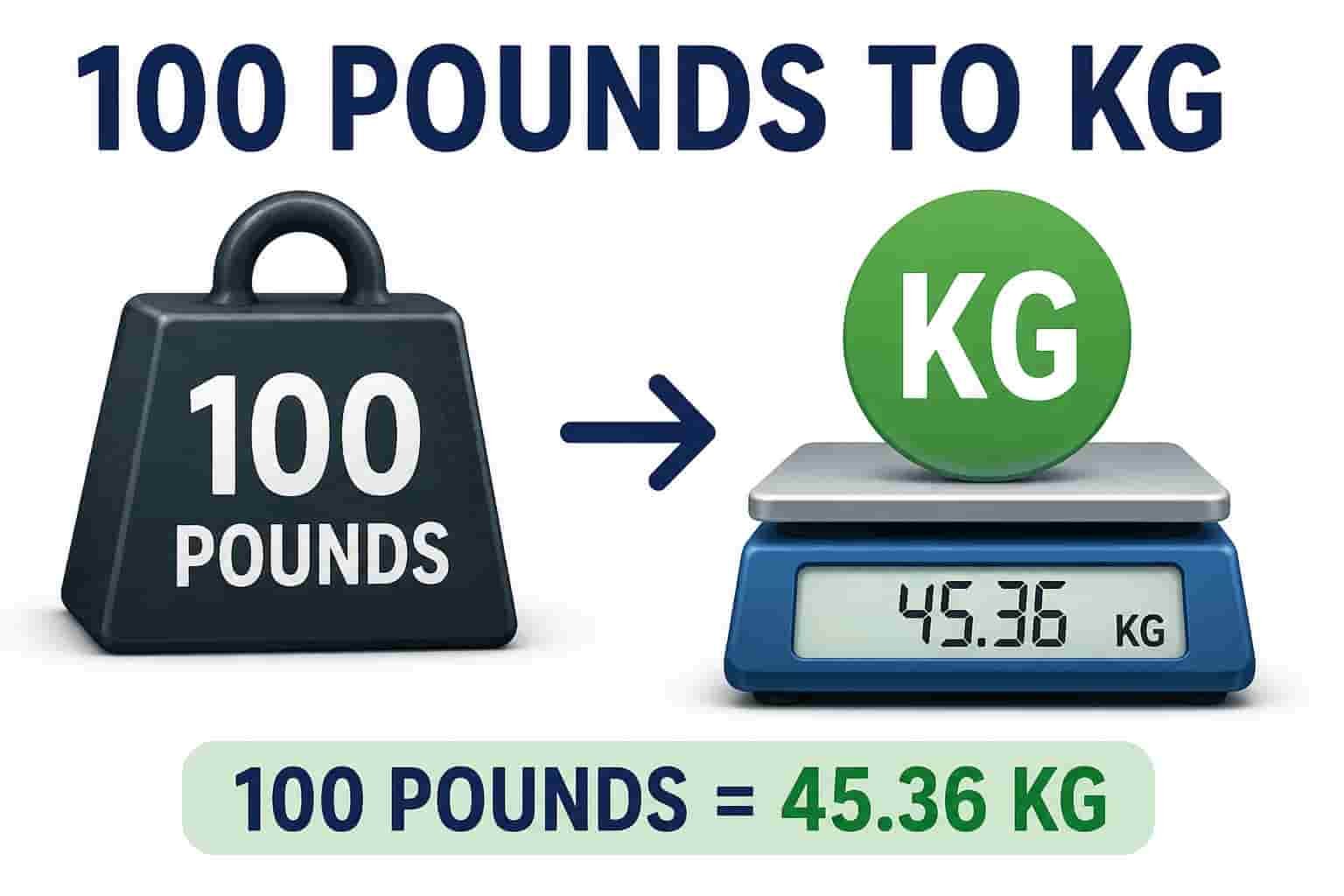
In simple terms, 100 Pounds to KG equals approximately 45.36 kilograms. But there is more to learn than just the final number. In this guide, you will discover how to convert pounds to kilograms step by step, with real-life examples, helpful tips, and common mistakes to avoid.
This article is designed for beginners, so even if you have never done unit conversions before, you will find everything easy to follow and practical
What Does 100 pounds in kg mean?
The phrase 100 Pounds to KG refers to converting a weight measurement from pounds (lb), commonly used in the United States, to kilograms (kg), which is the standard unit in most countries.
- 1 pound (lb) = 0.45359237 kilograms (kg)
- 100 pounds = 45.3592 kilograms (rounded to 45.36 kg)
So, when someone says 100 pounds to KG, they are asking: “What is 100 pounds in kilograms?”
This conversion is widely used in:
- Fitness and gym tracking
- International shipping
- Airline baggage rules
- Medical weight records
- Cooking and nutrition
Understanding this conversion ensures you avoid mistakes when dealing with international measurements.
Step-by-Step Guide to Convert 100 Pounds to KG
Let’s break down the process in a simple way so you can apply it to any weight.
Step 1 – Know the Conversion Formula
The basic formula is:
Kilograms = Pounds × 0.45359237
This is the most accurate conversion method used worldwide.
Step 2 – Apply the Formula
Now apply it to 100 Pounds to KG
100 × 0.45359237 = 45.359237 kg
Rounded off:
👉 100 pounds = 45.36 kg
Step 3 – Double-Check Your Result
If you want a quick estimate without a calculator, simply:
- Divide pounds by 2.2
100 ÷ 2.2 ≈ 45.45 kg
This is close to the exact value, making it useful for quick mental calculations.
Real-Life Examples of 100 Pounds to KG Conversion
Understanding [100 Pounds to KG] becomes easier when you see real-life situations where it is used.
Example 1: Fitness Tracking
A person weighing 100 pounds in the U.S. will weigh about 45.36 kg internationally. This helps when using fitness apps or gym equipment that uses metric units.
Example 2: Shipping Packages
If a parcel weighs 100 pounds, international shipping companies will treat it as 45.36 kg. This is important for calculating shipping costs.
Example 3: Travel Baggage
Airlines in many countries use kilograms. If your luggage is 100 pounds, you need to know it equals 45.36 kg to avoid overweight baggage fees.
These examples show why understanding 100 pounds to KG is useful in everyday life.
READ MORE GUIDE: How Many Kilograms in a Pound
Common Mistakes When Converting 100 Pounds to KG
Many people make errors when dealing with weight conversions. Here are the most common ones:
1. Using Rough Estimates Only
Some people always divide by 2. This gives a rough idea but not an accurate result.
2. Forgetting Decimal Precision
The correct conversion is 45.3592 kg, not just 45 kg. Small differences matter in medical or shipping situations.
3. Confusing Units
Pounds (lb) measure weight, while kilograms (kg) are metric units. Mixing them up leads to incorrect calculations.
4. Rounding Too Early
Rounding during steps instead of at the end can slightly change the final result.
Avoiding these mistakes ensures accurate use of [100 Pounds to KG] in all situations.
Helpful Tips for Easy Conversion
Here are some practical tips to make conversions faster and easier:
Use a Simple Rule
Remember:
1 lb ≈ 0.45 kg
Keep a Conversion Table
Having a quick reference chart for common weights like 50 lb, 100 lb, and 200 lb saves time.
Use Digital Tools
Online converters and mobile apps can instantly calculate 100 pounds to KG without manual work.
Practice Mental Math
With practice, you can estimate conversions quickly by dividing by 2.2.
These tips make everyday conversions smoother and reduce mistakes.
Why Understanding 100 Pounds to KG Is Important
Knowing how to convert 100 Pounds to KG is not just about numbers—it has practical benefits:
1. Global Communication
Many countries use kilograms. Understanding both systems helps you communicate better internationally.
2. Health and Fitness Accuracy
Fitness goals often rely on precise weight tracking. Converting correctly ensures better progress monitoring.
3. Avoiding Extra Costs
In shipping and travel, incorrect weight conversions can lead to extra charges.
4. Better Learning and Awareness
It improves your understanding of measurement systems and builds confidence in math-related tasks.
Quick Conversion Summary
To make things simple:
- 100 lb to kg = 45.36 kg
- Formula: Pounds × 0.45359237
- Quick estimate: Pounds ÷ 2.2
So whenever you see100 lb to kg to KG, you now know exactly how to convert it.
FAQ – 100 Pounds to KG
1. What is 100 pounds to kg exactly?
100 lb to kg is equal to approximately 45.36 kilograms.
2. Is 100 pounds to KG always 45 kg?
No, the accurate value is 45.36 kg. Rounding to 45 kg is only an estimate.
3. How do I quickly convert 100 pounds to KG?
Divide the weight in pounds by 2.2 to get an approximate result.
4. Why do we convert pounds to kilograms?
Because different countries use different measurement systems, especially in science, travel, and health.
5. Is the conversion of 100 pounds to KG the same everywhere?
Yes, the conversion formula is universal and does not change.
Conclusion
Understanding 100 Pounds to KG is very useful in daily life, especially when dealing with international measurements. Whether you are tracking fitness progress, shipping goods, or traveling, knowing that 100 pounds equals 45.36 kilograms helps you stay accurate and confident.
With the simple formula and examples shared in this guide, you can now convert pounds to kilograms easily without confusion. Remember, practice makes it even faster, and soon you’ll be able to estimate conversions instantly.
If you ever need a quick answer, just recall that 100 pounds to KG is approximately 45.36 kg—and you’re good to go.
