

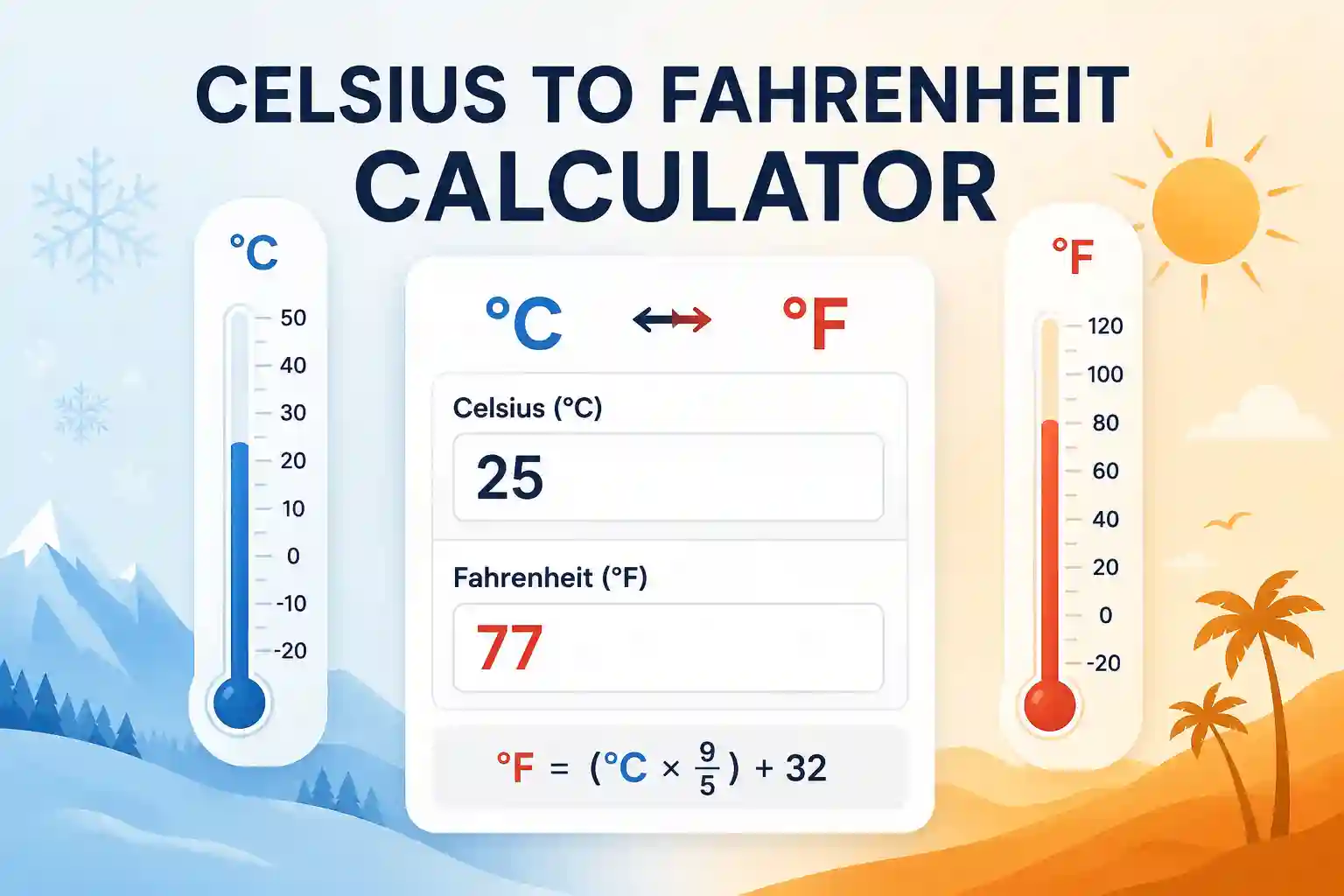
Temperature conversion is essential in science, weather forecasting, cooking, engineering, healthcare, and everyday life. While many countries use the Celsius scale, others—most notably the United States—primarily use Fahrenheit. A reliable Celsius to Fahrenheit Calculator helps users instantly convert temperatures accurately without manual calculations.
Whether you’re checking international weather forecasts, following a recipe, interpreting laboratory measurements, or studying science, understanding temperature conversion saves time and prevents mistakes.
In this comprehensive guide, you’ll learn how Celsius and Fahrenheit work, the mathematical formula behind conversions, practical examples, conversion tables, and frequently asked questions.
What Is Celsius?
The Celsius scale (°C), formerly known as the centigrade scale, is the world’s most widely used temperature measurement system.
It is based on water’s physical properties:
| Reference Point | Celsius |
| Water freezes | 0°C |
| Water boils (at sea level) | 100°C |
The Celsius scale is part of the International System of Units (SI) and is used in nearly every country worldwide for weather reporting, education, science, and everyday measurements.
What Is Fahrenheit?
The Fahrenheit scale (°F) is primarily used in the United States and a few other territories.
Its major reference points are:
| Reference Point | Fahrenheit |
| Water freezes | 32°F |
| Water boils | 212°F |
Unlike Celsius, Fahrenheit divides the freezing and boiling points of water into 180 degrees instead of 100.
Because of its smaller degree intervals, some people find Fahrenheit more precise for describing everyday weather conditions.
Celsius to Fahrenheit Formula
The conversion formula is straightforward:
°F = (°C × 9/5) + 32
Or:
°F = (°C × 1.8) + 32
Example 1
25°C
(25 × 9/5) + 32
45 + 32
77°F
Example 2
0°C
= (0 × 9/5) + 32
= 32°F
Example 3
100°C
(100 × 9/5) + 32
180 + 32
212°F
Why Use a Celsius to Fahrenheit Calculator?
Although the formula is simple, manual calculations can become inconvenient when converting multiple values or decimal temperatures.
Benefits include:
- Instant conversion
- Improved accuracy
- No mathematical errors
- Faster calculations
- Useful for students, travelers, chefs, researchers, and professionals
- Works on mobile and desktop devices
Modern online calculators also eliminate rounding mistakes commonly made during mental calculations.
READ MORE GUIDE: 5 Feet 6 Inches in CM: Complete Height Conversion Guide
Common Celsius to Fahrenheit Conversion Chart
| Celsius | Fahrenheit |
| -40°C | -40°F |
| -30°C | -22°F |
| -20°C | -4°F |
| -10°C | 14°F |
| 0°C | 32°F |
| 5°C | 41°F |
| 10°C | 50°F |
| 15°C | 59°F |
| 20°C | 68°F |
| 25°C | 77°F |
| 30°C | 86°F |
| 35°C | 95°F |
| 40°C | 104°F |
| 50°C | 122°F |
| 100°C | 212°F |
This table covers the temperatures people encounter most frequently.
Everyday Uses of Temperature Conversion
Temperature conversion appears in many real-life situations.
Weather Forecasts
Travelers often compare forecasts between countries using different measurement systems.
For example:
- London: 18°C
- New York equivalent: 64.4°F
Cooking
International recipes frequently list oven temperatures in Celsius.
Example:
| Celsius | Fahrenheit |
| 160°C | 320°F |
| 180°C | 356°F |
| 200°C | 392°F |
| 220°C | 428°F |
Correct conversions help avoid undercooked or overcooked meals.
Healthcare
Medical thermometers may display temperatures in either Celsius or Fahrenheit.
Normal human body temperature:
- 37°C
- 98.6°F
A fever generally begins around:
- 38°C
- 100.4°F
Healthcare professionals rely on precise conversions when communicating internationally.
Science and Engineering
Researchers, laboratories, and engineers often work with SI units (Celsius), while collaborating with organizations using Fahrenheit measurements.
Accurate conversion ensures consistency across reports and experiments.
Manual Calculation Tips
If you don’t have internet access, you can estimate Fahrenheit quickly.
Quick Approximation
Multiply Celsius by 2.
Then subtract about 10%.
Finally add 32.
Example:
20°C
20 × 2 = 40
Minus 4 = 36
36 + 32 = 68°F
The approximation works reasonably well for everyday estimates.
Real-World Temperature Examples
| Situation | Celsius | Fahrenheit |
| Comfortable room | 22°C | 71.6°F |
| Refrigerator | 4°C | 39.2°F |
| Freezer | -18°C | -0.4°F |
| Average body temperature | 37°C | 98.6°F |
| Hot summer day | 35°C | 95°F |
| Boiling water | 100°C | 212°F |
These examples make it easier to visualize converted temperatures.
Understanding the Difference Between Celsius and Fahrenheit
| Feature | Celsius | Fahrenheit |
| Water freezes | 0°C | 32°F |
| Water boils | 100°C | 212°F |
| Degree interval | Larger | Smaller |
| SI Standard | Yes | No |
| Common use | Most countries | United States |
Both systems accurately measure temperature; they simply use different scales.
Interesting Facts About Temperature Scales
- Swedish astronomer Anders Celsius introduced the Celsius scale in 1742.
- Daniel Gabriel Fahrenheit developed the Fahrenheit scale in 1724.
- Nearly every country has adopted Celsius for official weather reporting.
- The United States remains the largest nation using Fahrenheit in daily life.
- Both temperature scales meet at -40°, where -40°C equals -40°F.
Scientific Accuracy and Standards
Temperature measurement plays a vital role in numerous industries.
According to the International Bureau of Weights and Measures (BIPM), Celsius is derived from the SI base unit, the kelvin, making it the internationally accepted standard for scientific measurement.
Meanwhile, organizations such as the World Meteorological Organization (WMO) recommend Celsius for global meteorological reporting, ensuring consistency across countries.
Reliable conversion tools minimize errors that could affect laboratory experiments, industrial processes, medical reporting, and engineering calculations.
Common Conversion Mistakes
Avoid these frequent errors:
Forgetting to Add 32
Many people calculate:
25 × 1.8 = 45
and mistakenly stop there.
The correct answer is:
45 + 32 = 77°F
Reversing the Formula
The Fahrenheit-to-Celsius formula is different.
Never interchange the two formulas.
Incorrect Multiplication
Remember:
9 ÷ 5 = 1.8
Not 1.5.
Rounding Too Early
Perform the complete calculation before rounding the final result.
Benefits of Using an Online Temperature Calculator
Modern calculators offer several advantages:
- Instant calculations
- High precision
- Mobile-friendly interface
- Supports decimal temperatures
- No manual errors
- Free accessibility
- Helpful for students and professionals
Many websites also allow reverse conversions between Fahrenheit, Celsius, and Kelvin.
Frequently Asked Questions
What is the formula for converting Celsius to Fahrenheit?
Use:
°F = (°C × 9/5) + 32
This is the standard conversion formula used worldwide.
Why does Fahrenheit start at 32 for freezing?
The Fahrenheit scale was designed using historical reference points established by Daniel Gabriel Fahrenheit before modern scientific standards existed.
Is Celsius more accurate than Fahrenheit?
Neither is inherently more accurate. Both measure temperature precisely. Fahrenheit uses smaller degree increments, while Celsius aligns directly with the metric system and SI standards.
Why do scientists use Celsius?
Scientists commonly use Celsius because it integrates with the International System of Units and relates directly to Kelvin, the SI base unit for temperature.
Where is Fahrenheit still used?
Fahrenheit remains the primary temperature scale in the United States and is also used in a few territories and countries for everyday weather reporting.
What temperature is room temperature?
Typical room temperature ranges from:
- 20–22°C
- 68–72°F
What is normal human body temperature?
Average body temperature is approximately:
- 37°C
- 98.6°F
However, slight variations are normal depending on age, time of day, and measurement method.
What is the easiest way to convert Celsius to Fahrenheit?
The easiest method is to use an online Celsius to Fahrenheit Calculator, which instantly applies the correct formula and reduces the chance of calculation errors.
Conclusion
Converting temperatures between Celsius and Fahrenheit is a practical skill used in everyday life, travel, healthcare, cooking, education, and scientific work. Converting temperatures between Celsius and Fahrenheit is a practical skill used in everyday life, travel, healthcare, cooking, education, and scientific work. While the mathematical formula is straightforward, using a dedicated calculator provides fast, accurate, and error-free results for any temperature value.
Understanding how the two scales relate also makes it easier to interpret international weather reports, recipes, laboratory data, and medical readings. Whether you’re converting a single value or many temperatures, knowing the formula and keeping a conversion chart handy can save time and improve accuracy.
